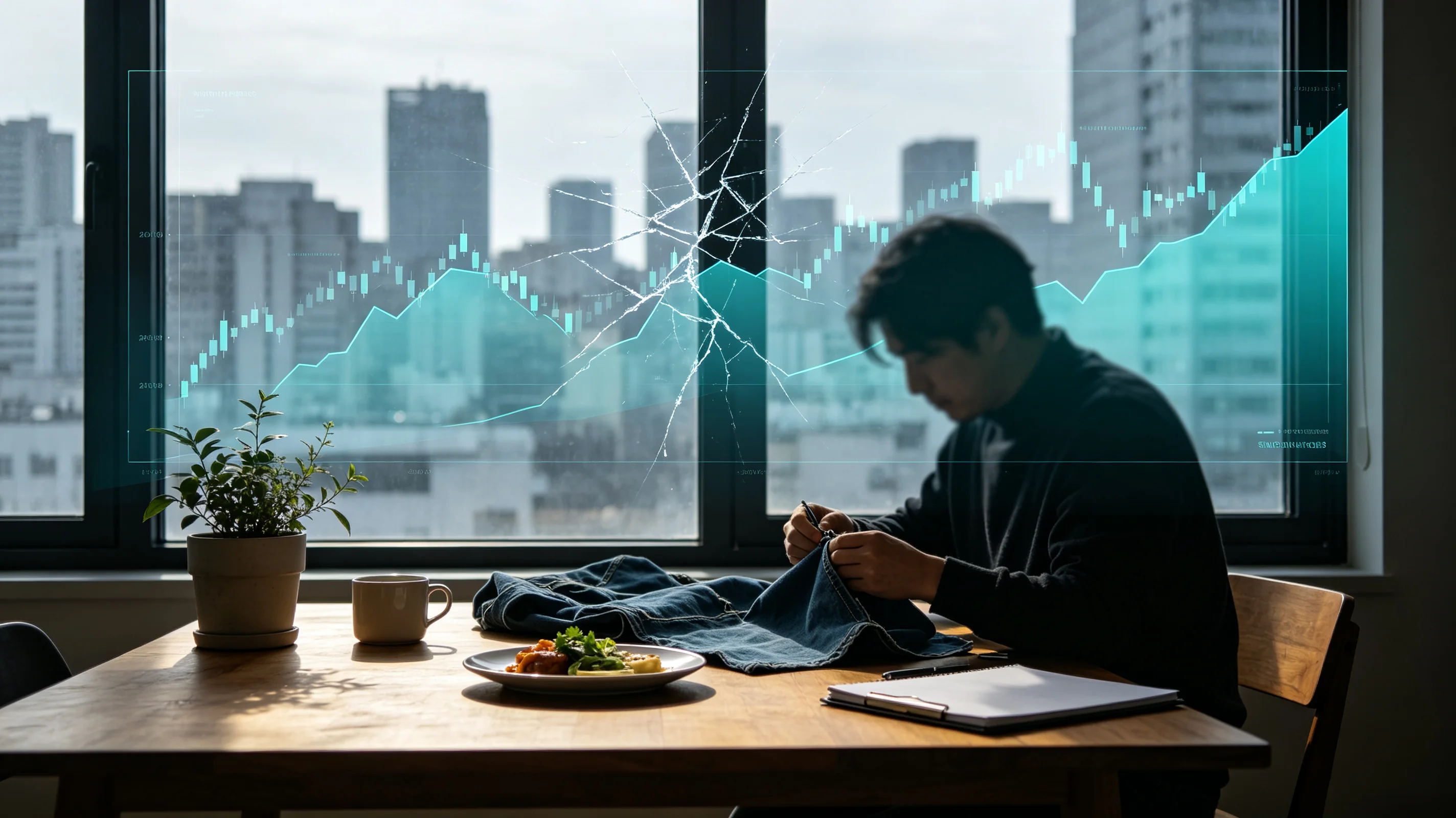
Q1: From "Premium Mediocre" to "Frugal Optimism," how exactly has the consumer’s psychological defensive line been deconstructed and rebuilt?
A: This is a total, root-and-branch transformation of locker-room politics. In the past, the narrative of Western consumerism was a piece of meticulously calculated tactical deception—it preached that the limited-edition sneakers on your feet and the artisanal coffee in your hand dictated your tactical authority in the social hierarchy. However, consecutive years of high inflation have completely smashed through that hollow hardwood floor. The moment a gallon of milk and a basic plate of pasta began staging aggressive takeovers of the monthly ledger, the old "Premium Mediocre" defensive dam suffered a catastrophic breach.
The underlying logic of "Frugal Optimism" is a sovereign reclaiming of existential resources. It is not a bitter, defeated surrender; it is an unyielding, defiant response delivered with an arrogant smirk and a touch of veteran elegance. Consumers have realized that the most lethal trash talk you can hurl at inflation isn't "I can afford this," but rather, "I don't even need it."
The Conversion of Emotional Fuel: In the old playbook, purchasing a luxury item bought you a brief, 30-minute dopamine spike. Today, scouring a weekend thrift market or utilizing the "Buy Nothing Project" network to secure a vintage 1970s wool overcoat for free yields a psychological high and a sense of intellectual dominance that lasts for months.
Rebuilding Trust Equity: Consumers are no longer depositing their sense of security into fiat paper that depreciates by the second under inflationary pressures. Instead, they invest it into their own psychological resilience—their ability to turn a low-cost existence into a masterful art form. This brand of optimism is the cold, knowing sneer of an old ballplayer who has seen right through the house's tricks.
Q2: With "Slow Living" now crowned as the absolute darling of the environmental and design circles, how exactly does it execute a dimensional destruction on the fast-paced marketplace?
A: Let’s be crystal clear about one thing: the sudden explosion of Slow Living is not the superficial, influencer-curated aesthetic of "sipping tea in curated sunlight" found in glossy PR copy. It is a brutal defensive squeeze play designed to suffocate fast fashion and mindless consumerism.
The core engine of fast fashion is a toxic loop: manufacture anxiety, iterate at hyper-speed, and discard immediately. It is a high-frequency, relentless trap designed to slaughter both the consumer's wallet and the planet's resource reserves. Slow Living is the heavy iron club swung by the eco-conscious contingent to shatter that engine's momentum.
Ecosystem Showdown: Fast Fashion vs. Slow Living
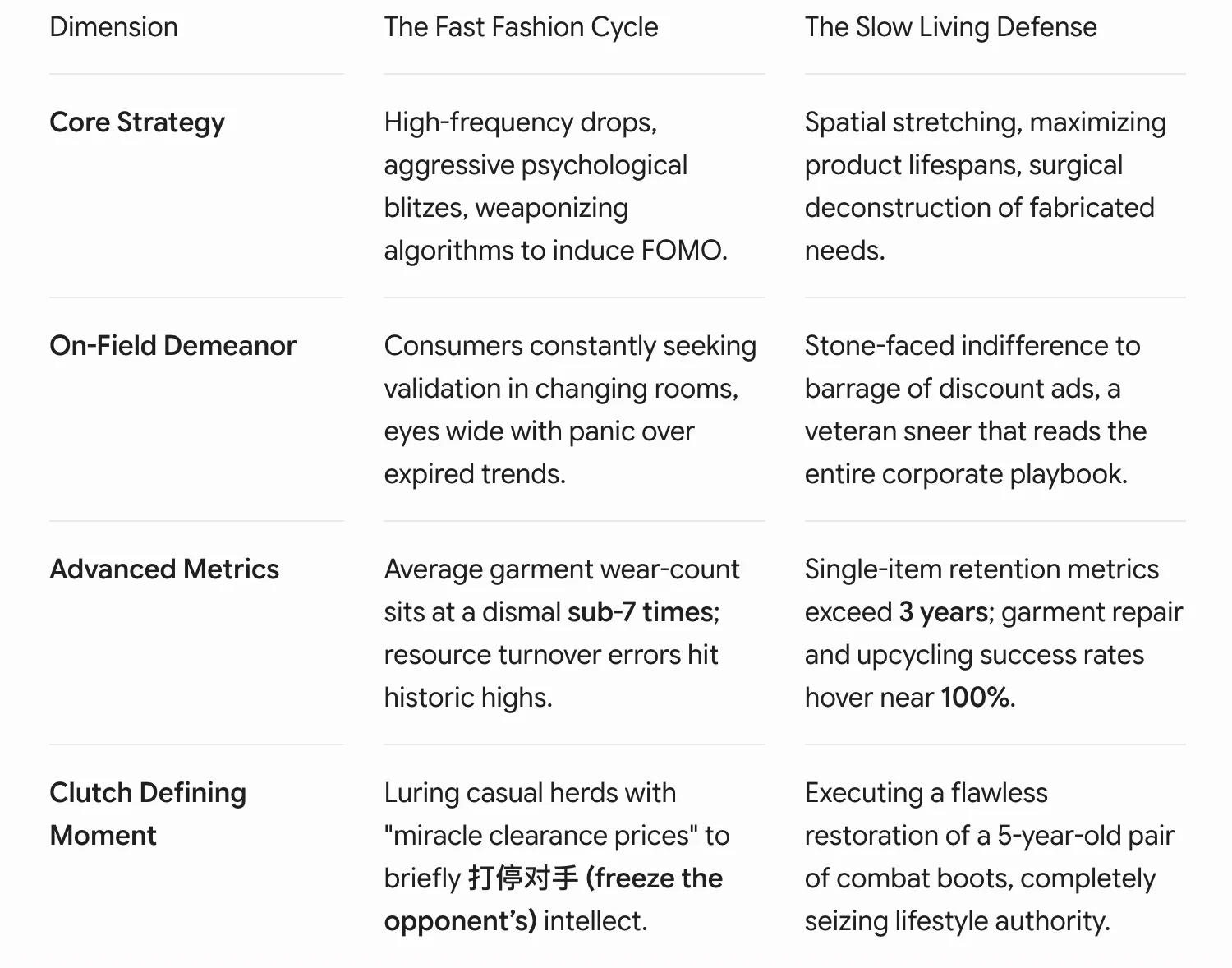 Slow Living’s dimensional destruction of the fashion landscape lies in how it drags the toxic habit of "out with the old" to the execution dock, replacing it with the badge of "built to last." A garment’s value is no longer validated by whether it dropped this morning, but by how many grueling seasons it has survived with you in the trenches. This structural shift in time-horizon leaves the once-invincible fast-fashion empires in a state of late-game learned helplessness.
Q3: Within this slow revolution, what are some of the "miracle plays" that look incredibly thrifty on the surface but are actually elite flexes? How are local die-hards running these tactical adjustments?
A: True veterans never bother pretending they’re swimming in cash; they excel at creating historic highlights in the blind spots of the corporate playbook. In the Western low-cost movement, there are a few maneuvers that land squarely in the tactical strike zone:
The Assassin's Edge of "Visible Mending": Traditional consumerism dictates that the moment a garment tears, it belongs in the landfill. Today’s Slow Living die-hards counter with a brilliant, aggressive response: using contrasting embroidery threads or traditional Japanese Sashiko stitching to deliberately spotlight the garment's wounds. This patch isn't a fig leaf to cover poverty; it’s a medal of honor earned via a personal soul massage applied to the fabric. It is a declaration to the fast-fashion industrial complex: my taste will not be dictated by your supply chain assembly lines.
The Sovereign Food Authority of "Urban Homesteading": Since grocery store organic tomatoes are priced like an armed robbery, local die-hards have bypassed the system entirely, executing a clean handoff of home-court sovereignty right on their balconies and community plots. They construct miniature ecosystems using discarded bottles and wooden pallets, cultivating seeds and managing compost. When a plate of pasta topped with homegrown basil and fresh tomatoes hits the table, the trust equity forged in the ruins of inflation is something no Michelin-starred joint can replicate.
Clubhouse Insider Report: In the social circles of London and New York youth, the ultimate flex is no longer checking in at the latest hyped restaurant over the weekend. It's showing up with a picture saying, "Look at this sourdough loaf I wild-fermented myself using last week’s stale bread crusts." That ability to weaponize scrap material into pure emotional fuel is the absolute pinnacle of Frugal Optimism.
Q4: Has the sweeping popularity of this movement triggered an internal clubhouse undercurrent or a trust crisis regarding class identity within the Western middle class?
A: A razor-sharp observation. Every major realignment of lifestyle choices inevitably carries a covert struggle for class authority. And here, a subtle locker-room undercurrent absolutely exists.
For decades, the elite establishment used carbon-heavy, hyper-disposable luxury consumption to benchmark their status. But under the onslaught of Frugal Optimism, that behavior is suffering a total defensive collapse in the court of public opinion. A household that drives a gas-guzzling truck, hoards disposable fast fashion, and fills its garage with plastic waste now looks unrefined, uncultivated, and utterly lacking in psychological resilience through the lens of the slow movement.
However, there is a dangerous piece of tactical deception embedded within this shift:
Certain survival strategies that were originally forced upon the lower-income working class out of sheer economic necessity—such as patching garments, growing your own food, and bike-commuting—have been thoroughly sanitized, commercialized, and repackaged by eco-influencers into an expensive, high-barrier "Slow Living Experience." While the truly vulnerable struggle for survival, a segment of the affluent class plays dress-up, treating that struggle like a spiritual haute-couture runway. Dissolving this trust crisis requires authentic, community-level play. Only when "non-consumption" manifests as genuine, mutual aid among neighbors—rather than aesthetic posturing for digital clout and algorithmic traffic—can this slow undercurrent truly translate into healthy team resilience.
Post-Game Press Conference: Inside the Macro Strategy
Q: Will this wave of "Frugal Optimism" and "Slow Living" turn out to be a fleeting, manufactured trend like previous fast-fashion buzzwords, or will it fundamentally rewrite the underlying consumer ecosystem of the Western market?
Corporate Institutional Line: "This is merely a cyclical, reactionary behavior dictated by a specific economic downturn. Once inflationary pressures recede and purchasing power normalizes, global supply chains and high-velocity consumption will inevitably revert to baseline."
Psychological Analyst Breakdown: Do not buy into the corporate PR copy; they are gambling on consumer amnesia. The reality is that once a consumer's psychological defensive line is re-engineered, it cannot easily retrogress. Once an individual tastes the immense emotional fuel of reclaiming their time, repairing their own goods, and cultivating self-sufficiency, forcing them back onto the algorithmic treadmill of fast fashion will trigger an immediate, violent rejection.
The coronation is already complete. Inflation was merely the catalyst; humanity's primal craving for self-sovereignty over their lives is the actual engine. The tide of consumerism isn't just receding; the local die-hards are actively digging an entirely new riverbed with their own hands.
The Ultimate Romance of Dancing in the Ruins
When the final outs of the bottom of the ninth are recorded, the grinding corporate clock and the red-lined inflation charts remain inescapable realities. But the Frugal Optimists of Toronto, London, and New York are currently in the locker rooms they built with their own hands, spinning vintage vinyl and pouring glasses of home-brewed cider.
On paper, this lifestyle shift looks like a forced retreat dictated by a battered wallet. In reality, it is a comprehensive victory of psychological warfare. The slow movement capitalized on the exact windows of anxiety manufactured by capital, executed brilliant adjustments during high-stakes timeouts, and delivered consecutive, heavy impacts that shattered consumerism’s hold over the human psyche.
Across the grueling marathon of a lifetime's season, the wealth in your pockets will fluctuate with economic cycles. But the trust equity and autonomous dignity salvaged in a psychological chess match against material desire will become your most impregnable mental fortress. This cost-free, silent revolution is the ultimate romance of human competitors using pure flesh and willpower to stare down the grinding teeth of an era.
Transparency Disclosure: Content here is for informational guidance. This publication maintains editorial independence, though some links may generate affiliate revenue. For copyright inquiries or content removal, please reach out to our desk.