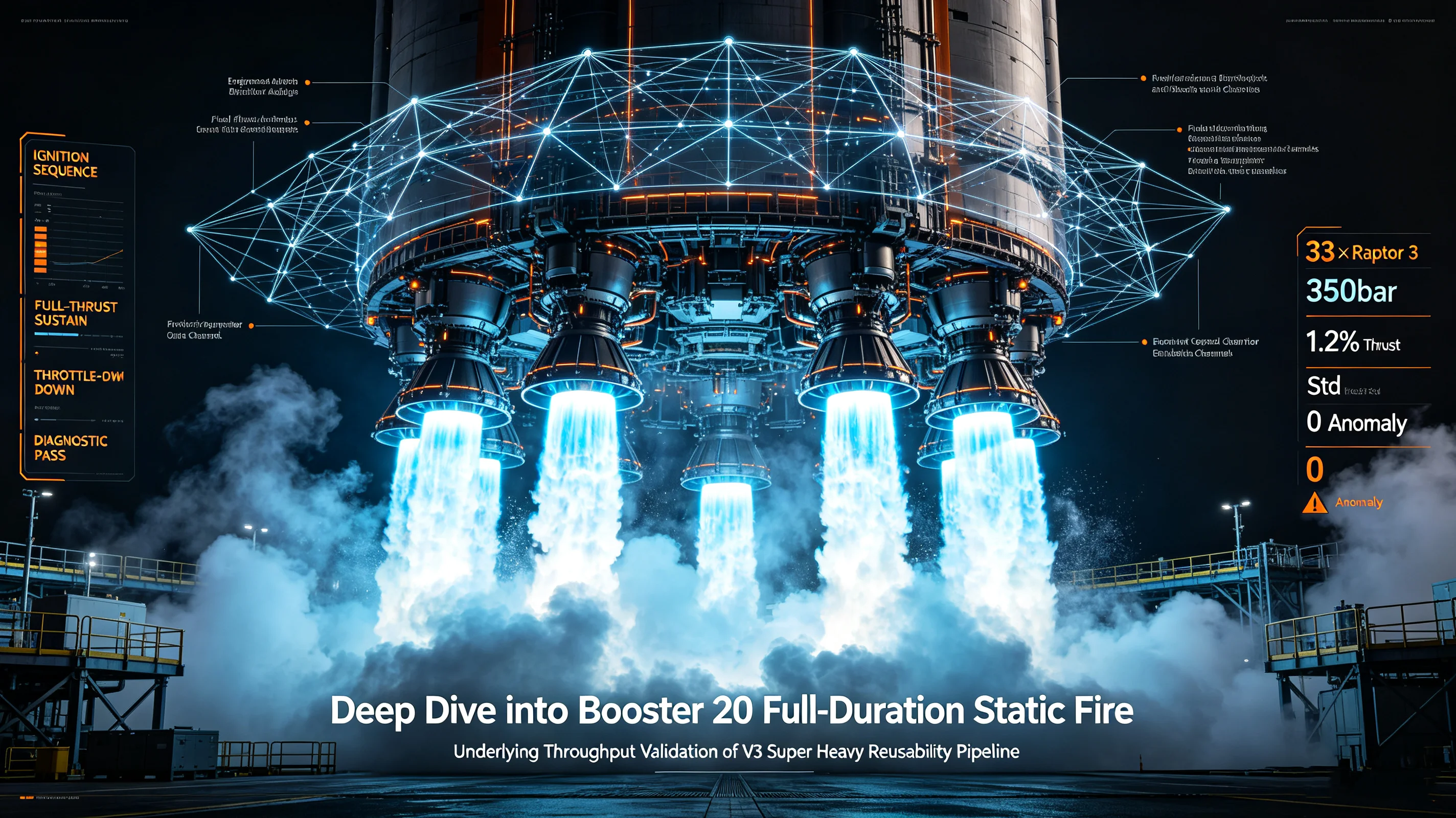
Following SpaceX's public filing of its Form S-1 registration statement with the SEC, the company officially announced its debut on the Nasdaq exchange for June 12. Priced at $135 per share, commanding a staggering $1.77 trillion valuation, and aiming to raise a historic $75 billion—this massive blitz of unprecedented financial metrics leaves the global market asking a fundamental question: How will this record-shattering IPO elevate Elon Musk into an entirely new realm of capital, and how will it rewrite the fates of thousands of everyday employees? Beyond the astronomical figures lies a masterclass in long-term strategic arbitrage and organizational incentive design.
In this capital tsunami, we are witnessing far more than the coronation of a technological empire; it is a textbook deployment of compounding productivity and shared risk.
01. From Megarich to the World’s First Trillionaire: Musk’s Multi-Industry Leverage
If the June 12 listing proceeds as engineered, Wall Street projections indicate that this public debut will catalyze the ascension of the first trillionaire in human history.
Elon Musk holds an approximate 42% economic stake in SpaceX while firmly retaining over 85% of the total voting power via super-voting Class B shares. Post-IPO, this single equity position is poised to settle near $750 billion. When paired with his Tesla equity and performance options valued upwards of $450 billion, Musk's net worth will comfortably breach the $1 trillion threshold. Prediction markets have aggressively priced this trajectory, indicating a 97% probability of Musk cementing his trillionaire status by 2028.
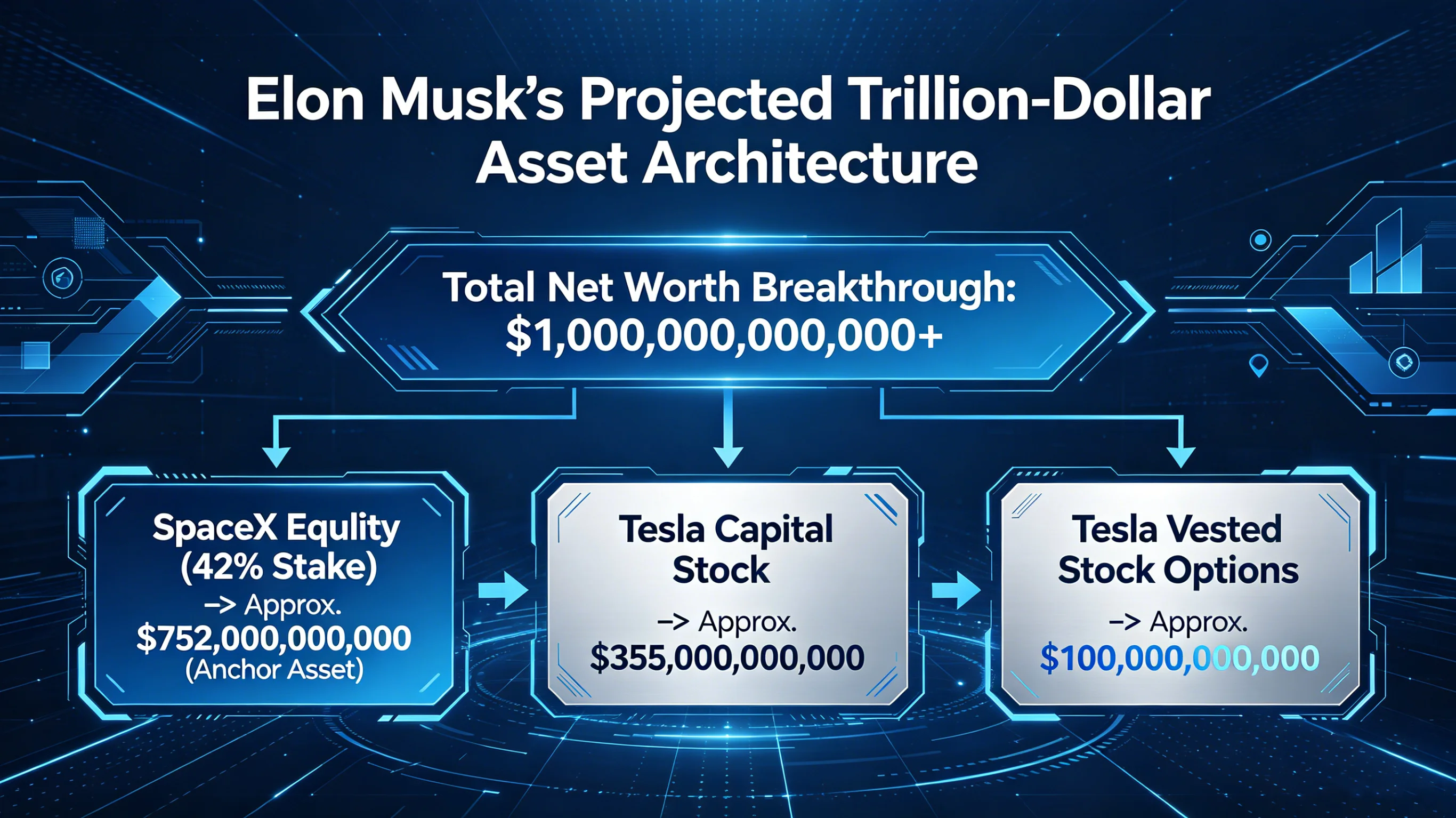 For professionals and operators navigating the modern economy, tracking the net worth of the ultra-wealthy offers little utility. The genuine learning value lies in decoding Musk's compounding productivity architecture.
Musk’s wealth expansion defies traditional caps because he treats the operational surplus of one enterprise as the structural lever for another. The algorithmic breakthroughs engineered via Tesla’s Full Self-Driving (FSD) stack directly optimized the foundation models of xAI's Grok. Simultaneously, xAI’s massive demand for compute compelled SpaceX to deploy high-density hardware clusters like the Memphis Colossus. SpaceX then monetized this over-provisioned infrastructure, locking in multi-billion-dollar compute leases with hyperscalers like Google and Anthropic. This cross-industry asset orchestration is precisely what propelled SpaceX's valuation to $1.77 trillion on the eve of its listing, offering a vivid case study in industrial ecosystem loops.
02. From Welders to Baristas: The Mechanics of a 4,000-Employee Micro-Equity Miracle
Beyond the macroeconomic focus on Musk, a distinct metric buried within the prospectus has triggered extensive dialogue across global workforce communities: the IPO is projected to mint roughly 4,000 new millionaires among the rank-and-file staff.
The individuals on the receiving end of this wealth transformation are not exclusively executive vice presidents or elite silicon valley researchers. Among them are specialized welders who endured the intense Texas sun in Boca Chica to fuse the stainless-steel hulls of Starship, logistics coordinators managing high-frequency supply chains, and the internal service staff who sustained operations around the clock at headquarters.
This phenomenon illustrates the profound upside of a ubiquitous equity distribution framework paired with collective accountability.
Throughout SpaceX's grueling multi-decade journey, the extreme capital requirements and systemic volatility of commercial aerospace meant the company could not compete with the pure cash compensation offered by legacy big tech. Instead, the organizational strategy relied on distributing equity incentives and Restricted Stock Units (RSUs) into the deep capillaries of the workforce.
Organizational Alignment via Hard Hardware: When an employee watches a massive launch vehicle detonate on the pad, only to see the engineering loop achieve flawless recovery months later, their equity stops being an abstract paper asset. It becomes a tangible claim on a generational frontier.
The Yield on Long-Term Risk: The fixed $135 IPO price converts years of grueling development cycles and experimental failures into immediate liquidity for base-level employees. It demonstrates that when a company builds hard physical moats, the individuals who absorb the early risk reap the ultimate reward.
03. Institutional Optimism vs. Floor Realism: A Generational Moat or an Extravagant Raise?
A $1.77 trillion market capitalization assigns SpaceX a price-to-sales (P/S) multiple that exceeds traditional industrial parameters and pushes past the limits of pure-play enterprise software SaaS.
Legendary growth investor Ron Baron and lead underwriters like Morgan Stanley have pitched institutional allocators with aggressive long-term modeling. They argue that Starlink’s global constellation footprint, combined with its pivot into orbital computing hubs and off-world cloud infrastructure, positions SpaceX to target an annual revenue run rate of $3.4 trillion by 2040. In their assessment, the spatial economy represents the largest Total Addressable Market (TAM) in human history, projected to scale into a $28.5 trillion ecosystem.
Yet, beneath this institutional enthusiasm, technical and trading communities on Hacker News and Reddit have dissected the S-1 financial statements, identifying the sharp operational pressures driving the timing of this listing.
An experienced equities trader on Reddit’s r/stocks highlighted the underlying tension:
"The structural numbers in the prospectus reveal massive cash consumption. SpaceX generated a substantial $18.67 billion in revenue for 2025, but it recorded a deep net loss of $4.9 billion, driven largely by a heavy $6.4 billion drag from integrating its advanced computing infrastructure units.
Musk is executing this $135-per-share fixed listing because the private placement markets are hitting liquidity caps. The development costs for Starship and orbital data centers require continuous, capital-intensive deployment. By opening the floodgates to public markets, the company is raising $75 billion in fresh public liquidity to sustain its long-term capital expenditure without diluting internal private valuations."
Over on Hacker News, software engineers focused on the unique mechanics of the retail distribution allocation:
"SpaceX setting aside up to 30% of its IPO allocation for retail platforms like Fidelity and Robinhood is a highly irregular move for an institutional listing of this magnitude. It democratizes access, but it also creates a unique float dynamic.
We will likely see intense retail momentum drive a massive first-day surge, akin to recent high-profile infrastructure listings. However, the true test arrives over the next twelve months. Once the standard insider lock-up periods expire, the stock will have to defend its $1.77 trillion valuation based on pure operational margins rather than Musk's cultural premium. Starlink's recurring commercial revenue must outrun the hardware burn rate of the Starship program."
Expanding Consciousness or the Ultimate Capital Engine?
On the opening pages of SpaceX’s S-1 filing, the company reiterates its core mission: “To build the systems and technologies necessary to make life multiplanetary, to understand the true nature of the universe, and to extend the light of consciousness to the stars.”
With a $1.77 trillion valuation, global capital markets are assigning a precise monetary baseline to that existential thesis.
When the opening bell rings on Nasdaq on June 12, the ticker symbol SPCX will instantly become a live laboratory for modern economic theory. Will this public vehicle establish itself as the ultimate infrastructure asset class, insulated from planetary resource constraints, or will it be scrutinized as a brilliant corporate mechanism designed to fund heavy industrial infrastructure via public market enthusiasm?
The critical takeaway for modern market observers is clear: never miscalculate an operator who successfully merges heavy physical manufacturing, high-margin asset loops, and long-term ecosystem synergy. As thousands of welders, technicians, and engineers prepare for their financial settlement on June 12, the market is forced to confront a grander structural reality. Are we investing in a standard corporate entity, or are we financing the foundational infrastructure of a post-terrestrial economy?
Transparency Disclosure: Content here is for informational guidance. This publication maintains editorial independence, though some links may generate affiliate revenue. For copyright inquiries or content removal, please reach out to our desk.