01. The Great Devaluation: From Craft to Utility
For half a century, middle-class dignity rested on cognitive scarcity. Whether a lawyer, programmer, or analyst, you were essentially running a "boutique" centered on your brain. This professional threshold formed a natural moat, forcing corporations to pay a premium for your decision-making and expertise.
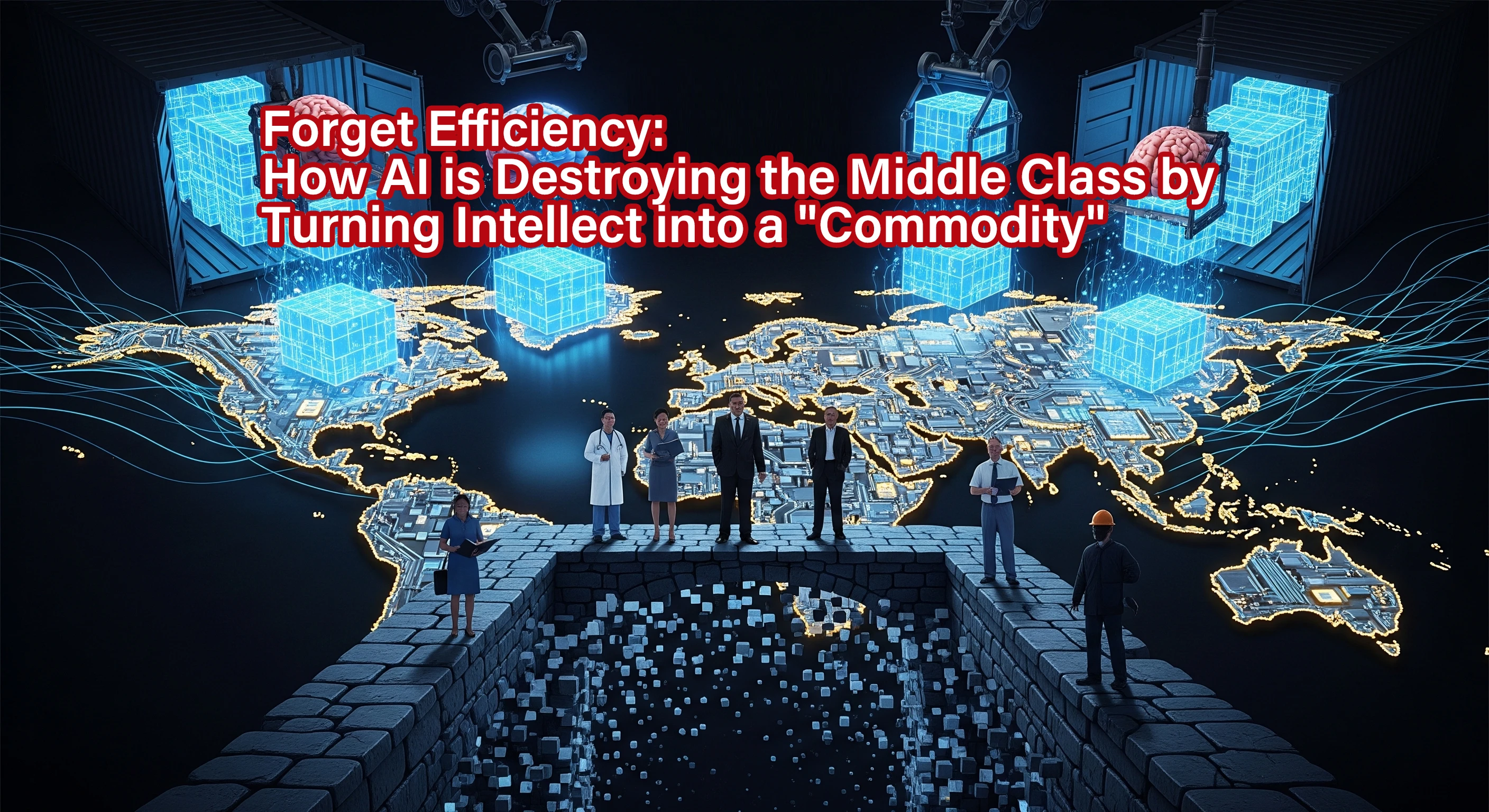
In the current landscape, this moat is collapsing. The impact of LLMs on intellectual labor mirrors that of mechanization on weavers in the 19th century: it turns "human-tempered craft" into "standardized current." When an LLM produces an 85th-percentile report for pennies, the barrier of professionalism vanishes. Intellect is no longer a scarce resource earned through years of study; it is a utility—on-demand and metered like water. This "democratization of intellect" has led to the mark-to-market devaluation of middle-class skills. Your talent is no longer unique; it is a statistical probability in a global compute pool.
02. The "Efficiency" Trap: A Race to the Bottom
The professional class is falling into a lethal logical trap: embracing AI-driven efficiency while ignoring capitalism’s coldest law—when supply becomes infinite, price approaches marginal cost. If you use AI to decuple your productivity, you do not gain ten times the free time; you simply shrink the unit price of your work by 90%. In an efficiency-driven system, excess productivity never belongs to the worker. As every white-collar professional engages in "efficiency-induced involution," they are collectively diluting their professional dignity. We are witnessing the "assembly-lining of white-collar work": you are no longer the protagonist of decision-making; you are merely a "proofreader" in an algorithmic output chain. This efficiency is built upon the stripping of your subjective agency. It is a total loss of professional sovereignty.
03. The Binary Economy: Owners vs. Operators
The disappearance of the middle class marks the evolution of social structure toward an extreme binary.
On one end are the rent-seekers of compute and algorithms. They don't engage in specific intellectual production, but they own the "land" (data centers and corpora) where it happens. They capture the vast majority of surplus value generated by civilizational progress. On the other end is commodity labor—including former elites whose jobs are now reduced to providing Reinforcement Learning from Human Feedback (RLHF) or spotting glitches in an algorithmic fog.
In this structure, the "middle ground" is a dead zone. AI excels at the very middle-management and analytical tasks that were the lifeblood of the professional class. When you cannot build a moat around your "uniqueness," you are relegated to the interchangeable labor pool. It is an era without moderation: you are either the god defining the algorithmic rules or the digital serf scheduled by them.
04. Tactical Survival: The Un-computable Resistance
If intellect has become a commodity, where is the exit for the professional class? The answer lies not in out-thinking AI logically, but in reclaiming the burdens beyond logic. We must focus on assets that cannot be tokenized:
Physical Provenance: Is your insight rooted in flesh-and-blood experience? In an era of synthetic noise, "real-world occurrence" is a massive premium.
Moral Accountability: AI can suggest, but it cannot suffer the consequences of failure. Only when a human stakes their reputation on a decision does that decision gain scarce commercial value.
Non-linear Narratives: AI is built on probabilistic prediction. Human intuition, bias, and even tragic persistence are the only variables capable of breaking the algorithmic loop.
Conclusion: The New Enclosure and the Human Fugitive
The commoditization of intellect is a "New Enclosure Movement." Our collective culture, experience, and thought are harvested into private servers and sold back to us as tokens.
The professional class must realize that "AI empowerment" is a gentle strangulation. To survive, we must refuse to be components in the algorithmic chain. We must seek out the clumsy, the slow, and the inefficient modes of interaction, for within them lies the "human dark matter" that no algorithm can parse. In a future where all intellect is billed by the watt, maintaining a degree of "un-utilizability" might be the only way to protect our souls.
Transparency Disclosure: Content here is for informational guidance. This publication maintains editorial independence, though some links may generate affiliate revenue. For copyright inquiries or content removal, please reach out to our desk.