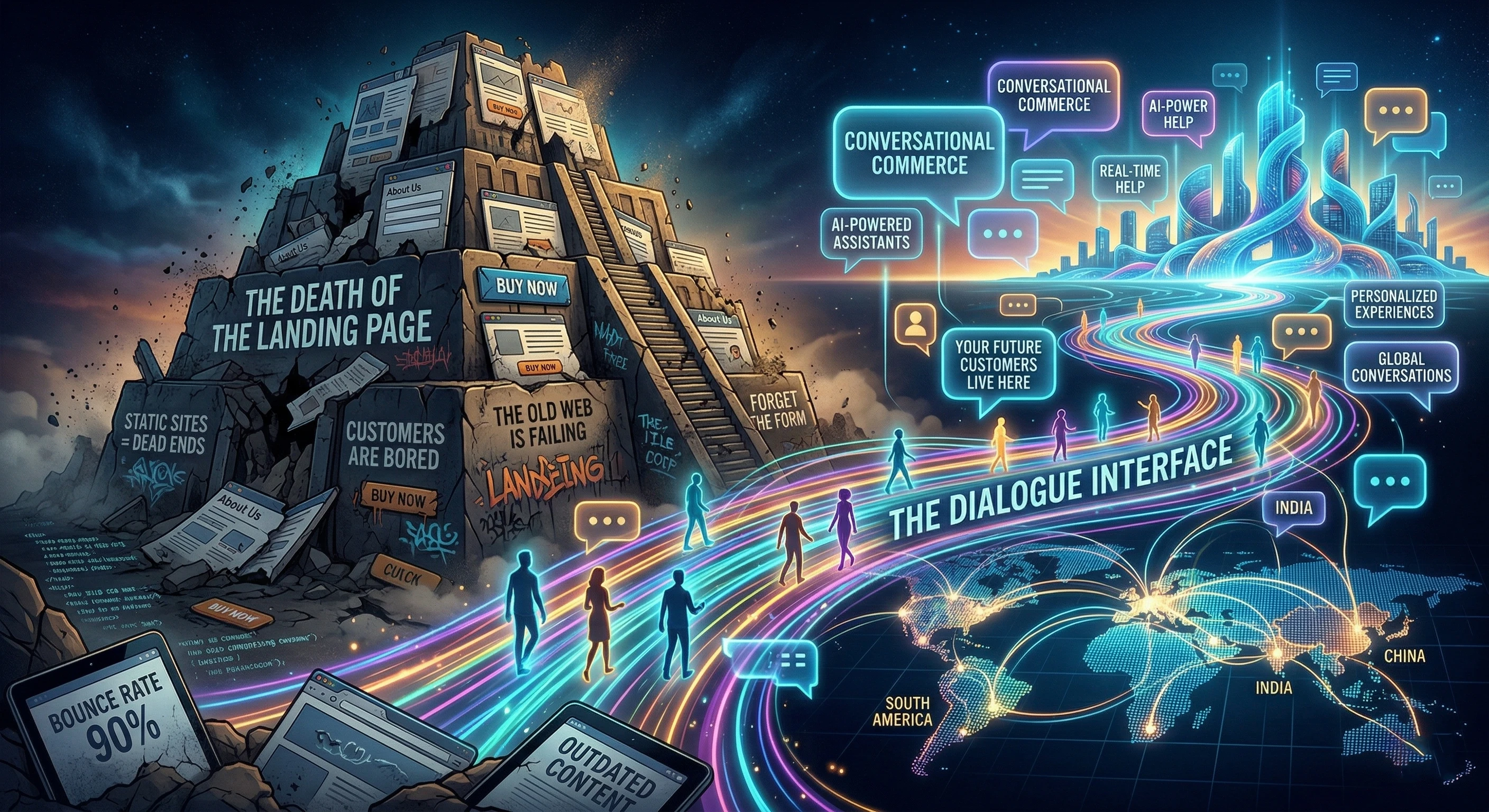
01\. The End of the Visual Monologue: From "Theater" to "Salon" Traditional landing pages are, at their core, a Visual Monologue. It is a one-way theater where the brand performs on stage while the user watches from the dark. The Arrogance of Design: Designers traditionally pre-determined the user’s movement—first the headline, then the hero image, then the CTA. This linear, industrial beauty is increasingly seen as arrogant and inefficient in the AI era. The Egalitarianism of Dialogue: The chat interface shatters this hierarchy. It is no longer "I show, you watch," but "You ask, I respond." The aesthetic center of gravity has shifted from Layout to Intent. In 2026, the peak of advertising design is no longer a "pretty page"; it is the architecture of a "Soulful Logic Chain." 02\. Responsive Aesthetics 2.0: Interfaces That "Read Minds" We once cheered for Responsive Design because it adapted to screen sizes. But the dialogue interface brings Cognitive Responsiveness. Traditional ad logic relied on A/B testing ten static variations to find the "winner." This was still a blind shot in the dark. In a dialogue interface, the "interface" is regenerated every second. Generative Layouts: Based on the depth of the user’s query, the AI adjusts the tone of voice, the granularity of information, and even generates custom visual charts on the fly—designed for that user alone. Dynamic Weighting: This aesthetic is no longer about static balance; it is Fluid Data Visualization. The interface is no longer a container; it is the immediate byproduct of the collision between brand will and user desire. 03\. Psychological Occupation: From "Conversion" to "Trust Duration" Landing page design focuses on Conversion Rate (CR)—an inherently aggressive metric. Dialogue interfaces focus on Resonance Depth. The Disappearance of the "Pitch": In a conversation, the act of selling is cloaked in the shell of consulting. The user no longer feels like a harvested lead, but like an understood individual. The Self-Persuasion Loop: When a customer inputs their anxieties, their budget, and their aesthetic preferences into a dialogue, they have already completed a deep process of "self-persuasion." The top advertisers of 2026 are no longer studying click-inducing copy; they are engineering interaction nodes with Emotional Intelligence. 04\. Conclusion: The Art of "White Space" in the New Era Designers, it’s time to stop obsessing over pixels. The most expensive "white space" of the future isn't the margin on a webpage; it is the "Space for Thought" left for the user during a conversation. The landing page is dying because it is too full—so full that it leaves no room for the user’s individuality. Customers no longer live in the perfect "digital model homes" you designed. They live in the fluid air of questions and answers. If your brand doesn't have a "mouth" that knows how to speak, you are effectively invisible in 2026.
Transparency Disclosure: Content here is for informational guidance. This publication maintains editorial independence, though some links may generate affiliate revenue. For copyright inquiries or content removal, please reach out to our desk.