I have always believed that if you feel absolute comfort in a place, you aren't traveling—you’re just sleeping in a different coordinate. Real travel should be like surgery performed without anesthesia; it cuts through your self-important assumptions, forcing you to see the raw anatomy of the world through the sting of the incision.
This April, I threw myself into the medina of Fes el-Bali. This is not a curated resort perfumed with air-conditioned convenience. It is a living, breathing labyrinth of nine thousand alleys—a silicon-resistant wasteland that flatly refuses to be tamed by an algorithm.
The Violence of Scent: Smelling the Base Layer of Life
If you asked me what Fes smells like, I’d tell you it is a violent collision of decay and fragrance. Long before you reach the heart of the old city, this scent has already set up camp in your nostrils via the searing heat.
Standing on a terrace overlooking the Chouara Tannery, clutching mint leaves provided by locals to fend off the pungent stench of pigeon droppings, lime, and raw hides, you are struck by a brutally honest logic: All that is exquisite and vivid is born from the filth of decomposition.
I watched the workers, legs bared to the sun, wading waist-deep in vats of dye. Their skin was stained russet and indigo, muscles gleaming hard under the sweat. They weren't performing "exoticism" for a travel channel; they were wrestling with existence. In that moment, any romanticized notions of "poetry and distant lands" shatter. You realize that the textures of civilization aren't born under gallery lights—they grow from this sediment of sweat, stench, and centuries of repetitive toil. It is the base layer of life, a raw and bloody dignity that requires no apology.
The Sovereignty of Being Lost: Where Algorithms Go to Die
In Fes, getting lost is not an accident; it is a sovereign right. It is, quite frankly, the only way to truly survive the city.
I tried turning off every GPS system on my phone—a redundant gesture. In these alleys, so narrow that the sky is a mere sliver, satellite signals stutter like a confused drunk. The blue dot on the map leaps frantically before freezing in despair at a dead end. Only when you surrender the obsession with finding the "correct route" does the real Fes begin to reveal itself.
You collide with donkeys carrying heavy timber, their expressions solemn, forcing you to press your back against the crumbling walls to avoid a brush with history. You hear the call to prayer echoing through the deep alleys—a sound that transcends time, leaving you uncertain if the year is 2026 or 1026. You catch the scent of freshly baked Khobz wafting from an oven around the corner; that steaming, primal comfort is a soul-level solace that no Michelin-starred kitchen can replicate.
Elite travelers now seek a state called "Raw Travel." It means you are no longer an observer trying to frame the world into a 16:9 social media crop; you are a participant swept up in the tide. When you stop trying to control the trajectory of the journey, the primal uncertainty of "not knowing who waits around the corner" becomes the cure for the soul-deep anxiety of an algorithmically-aligned life.
The Static Power of Time: Stripping the Self in a Riad
When night falls, the cacophony of hammering copper and street vendors recedes like a tide, replaced by a vacuum of silence so thick you can almost hear the dust settling on the zellij tiles.
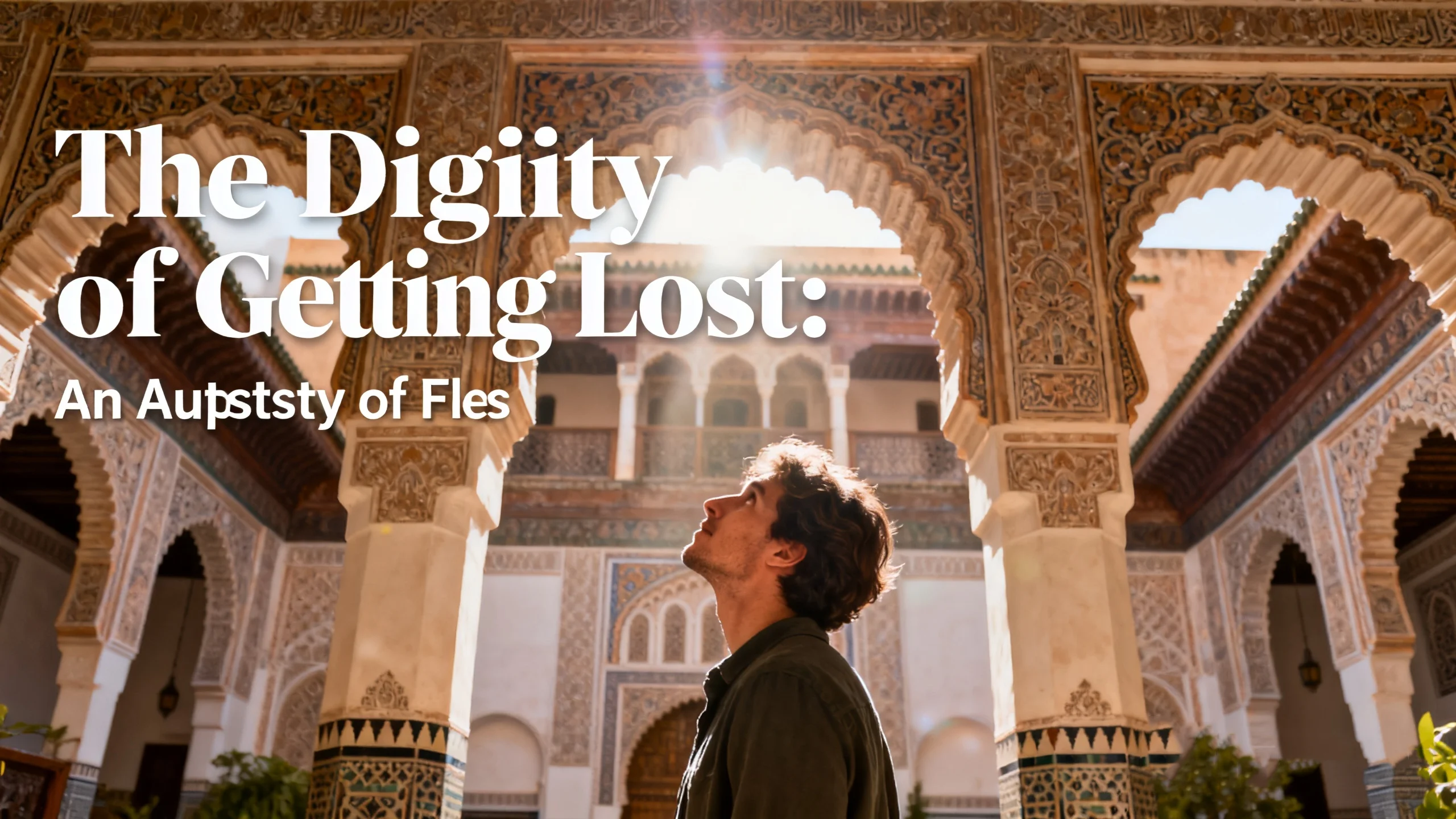
I stayed in a centuries-old Riad. Sitting in its courtyard, amidst the fountain’s whisper and intricate mosaics, I looked up at the tiny square of starlight framed by high walls. In that moment, you feel a massive loneliness—not the desolation of being abandoned, but the weight of making peace with time.
In an era where even leisure is measured by ROI, Fes tells you at a heart-stoppingly slow pace: some things do not need to evolve. The copper plates hammered by hand for a lifetime, the carpets that take months to weave, the games played in alleys for centuries—their existence is an elegant rebellion against a world obsessed with acceleration. Here, time is not money; time is the chisel that carves the soul.
The Hard Truth: Finding the Self Who Dares to be Disheveled
After reviewing countless luxury escapes and hidden gems, I’ve developed a strong professional instinct: We are losing the ability to be "un-composed."
We want the perfect photo, the precise itinerary, the risk-free "exoticism" filtered for comfort. Fes offers none of that. It will ruin your white shoes; it will make you sweat in its tangled veins; it will force you to realize how fragile your "modern superiority" actually is.
This weekend, I skipped the "must-see" landmarks. I sat on the stone steps near the Blue Gate, watching people in djellabas pass by, watching the sun crawl across ancient brickwork. I felt a power that needed no filter.
I brought back no polished souvenirs. I didn't take a single "epic shot" to dominate a feed. But I found a long-lost, undefined freedom.
In an age where every landscape is annexed by algorithms, real travel happens when you realize that the world’s original, coarse, and sometimes offensive reality is far more moving than any perfect illusion. I intend to stay lost in this labyrinth until I completely forget the data-tracked version of myself.
Transparency Disclosure: Content here is for informational guidance. This publication maintains editorial independence, though some links may generate affiliate revenue. For copyright inquiries or content removal, please reach out to our desk.