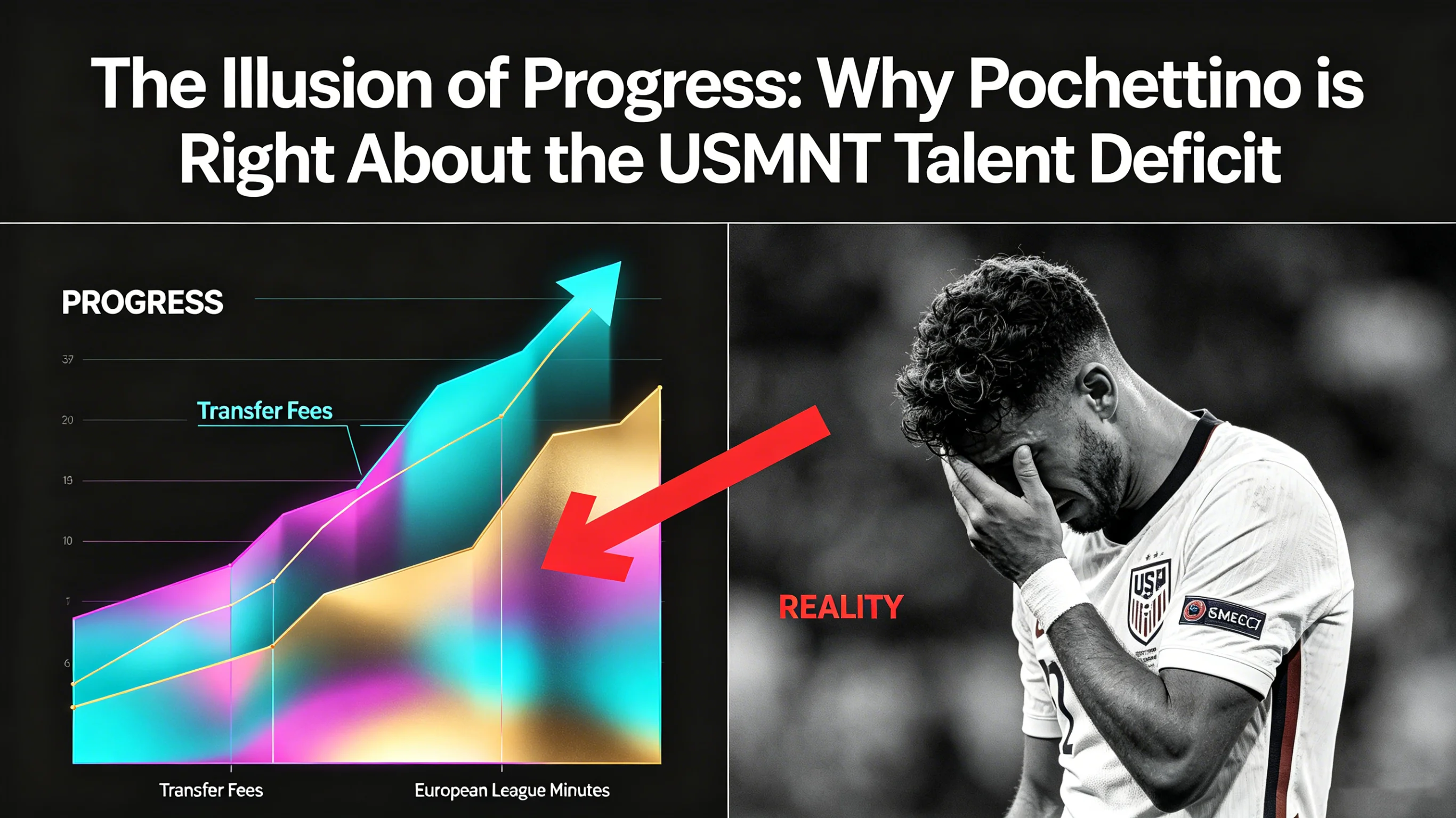
In global football discourse, no narrative has been more aggressively marketed over the past decade than the supposed “American soccer breakthrough.” Mainstream sports media, domestic federation marketing, and investor-backed football analytics platforms have coalesced around a single dominant storyline: the United States Men’s National Team (USMNT) sits on the cusp of sustained elite dominance, powered by an unprecedented generational talent wave. Public consensus holds that rising transfer fees for American players, growing academy enrollment numbers, and increased European league minutes constitute irreversible progress. The noise suggests the USMNT’s past tournament failures are temporary growing pains, minor blips on a trajectory toward World Cup contention and consistent top-tier international performance.
Mauricio Pochettino’s unvarnished assessment upon taking charge cut directly through this manufactured optimism. His blunt diagnosis of a systemic talent deficit was dismissed locally as overly harsh or out-of-touch with domestic growth metrics. Yet the friction between popular optimism and managerial realism exposes a fundamental logical flaw in how American football measures success. The industry conflates activity with quality, and market value with technical ceiling. Raw participation numbers, commercial valuation, and European club roster inclusion do not equate to elite football talent. They equate to a well-capitalized player export ecosystem built for monetization, not championship football. The mainstream consensus relies on surface-level vanity metrics while ignoring structural technical gaps that Pochettino, a coach trained in elite European developmental systems, recognizes instantly.
The core illusion stems from misinterpreting market signals as sporting signals. USMNT players command rising transfer premiums not because their technical ability outpaces international peers, but because they represent low-risk, high-commercial assets for European clubs. Young American athletes are athletically physical, linguistically adaptable, culturally compliant, and backed by a massive domestic media market that guarantees incremental commercial upside for any club that signs them. Their market value is tied to audience expansion and sponsorship potential, not pure footballing mastery. This creates a statistical distortion: the market inflates perceived talent while on-pitch technical fundamentals remain stagnant. The broader public consumes these inflated valuations as proof of progress, building a false narrative of generational superiority that collapses under high-stakes international competition.
To understand why the USMNT talent deficit persists despite visible industry growth, it is necessary to examine the underlying incentive structures that shape American player development. The entire domestic football ecosystem is optimized for player monetization rather than player mastery. Youth academies, professional leagues, and talent agencies operate within a capital distribution model that prioritizes short-term transfer revenue over long-term technical refinement. This structural incentive misalignment creates the persistent talent gap Pochettino identifies.
American youth football operates on a high-cost, pay-to-play developmental framework unique among elite football nations. Unlike European and South American systems that identify and polish low-income talent through free club academy pipelines, United States development filters participation through economic access. Talent selection prioritizes families capable of funding elite travel, private training, and academy fees, rather than identifying the most technically gifted athletes. This creates a systemic ceiling on overall talent depth. The system selects for privilege, athleticism, and physical maturity at early ages, while filtering out technically brilliant players from lower-income backgrounds who lack financial access. Early physical dominance creates temporary competitive advantages in youth tournaments, which misleads scouts and coaches into overrating raw athleticism over nuanced technical skill.
This incentive structure cascades upward into professional pathways. Major League Soccer’s business model is structured around roster cost control, league expansion revenue, and domestic viewership growth, not elite player production. MLS academies prioritize player profiles that translate easily to European second-tier leagues or mid-table first-tier squads: athletic, versatile, low-maintenance athletes with high commercial appeal. The system incentivizes coaches to develop safe, functional team players rather than risk developing stylistically unique, technically complex playmakers who require years of patient refinement. Coaches face career risk for grooming inconsistent but high-ceiling talent, while standardized, athletic role players generate reliable transfer revenue and league stability. Over time, the league produces a homogeneous player pool strong in physicality and work rate, weak in creative decision-making, positional nuance, and high-pressure technical execution.
The European loan and transfer market further reinforces this structural mediocrity. European clubs acquire American prospects primarily as developmental roster fillers and commercial assets. These players receive ample bench time and low-stakes league minutes, creating the illusion of elite integration, but they are rarely trusted with decisive in-game responsibilities in high-intensity fixtures. They accumulate statistical minutes without accumulating high-pressure footballing education. The incentive for European clubs is clear: they capture future transfer profit and American market exposure without investing resources into elite technical refinement. The result is a generation of USMNT players proficient in functional football but incapable of the granular decision-making and technical precision required to defeat top-tier international opposition.
Pochettino’s critique is not a criticism of individual players. It is a rejection of this entire misaligned incentive ecosystem. He recognizes that the USMNT’s consistent failure in knockout-stage football stems not from poor team chemistry or tournament luck, but from a developmental system engineered for commercial scalability rather than sporting excellence. The talent deficit is not a player deficit. It is a structural deficit baked into how the United States finances, selects, and develops football talent.
Moving forward, industry participants and observers must adopt a new framework for distinguishing genuine football progress from marketing-driven noise. Vanity metrics—transfer fees, league expansion figures, social media reach, and European roster appearances—must be discarded as measures of elite talent development. True footballing quality can only be evaluated through high-stakes behavioral metrics: consistent technical execution under defensive pressure, creative vertical passing volume, positional fluidity in structured opposition blocks, and in-game adaptive decision-making. These are the metrics that separate tournament contenders from commercially valuable squad players.
The future trajectory of the USMNT will not be determined by how many players join European leagues. It will be determined by whether domestic football institutions can rewrite their core incentive structures. Until the United States replaces its pay-to-play talent filtering system with need-blind technical scouting, prioritizes long-term player mastery over short-term transfer monetization, and rewards stylistic creativity over athletic compliance, the talent deficit will persist. The current generation of American footballers represents the peak of a commercial football model, not the arrival of an elite sporting model.
All capital and coaching resources directed toward scaling the existing system will continue to yield marketable athletes rather than tournament-winning footballers. Pochettino’s intervention serves as a necessary reality check for an ecosystem drunk on its own growth metrics. Progress measured in revenue and roster spots is not progress at all. Until the structural incentives change, the USMNT will continue cycling through talented athletes who lack the technical and cognitive ceiling to compete at the sport’s highest level.
Transparency Disclosure: Content here is for informational guidance. This publication maintains editorial independence, though some links may generate affiliate revenue. For copyright inquiries or content removal, please reach out to our desk.