01. The Failure of Digital Immunity
We once believed that cryptocurrencies or blockchains were the ultimate immutable assets. Reality has proven otherwise. In the face of AI’s "semantic bombardment," the most fragile element isn't the ledger—it’s human cognitive bandwidth.
When AI can perfectly simulate your social circle, your linguistic quirks, and even the subtle emotions you are currently experiencing, traditional advertising and public content distribution become "Digital Viruses." They disguise themselves as useful information to hijack your decision-making loops and harvest your attention.
In this environment, any content that relies on "Platform Distribution" is inherently brittle. The platform is the ultimate black box; it can mute your voice at any moment to optimize algorithmic efficiency.
02. Peer-to-Peer Neurons: The Sovereignty of Content
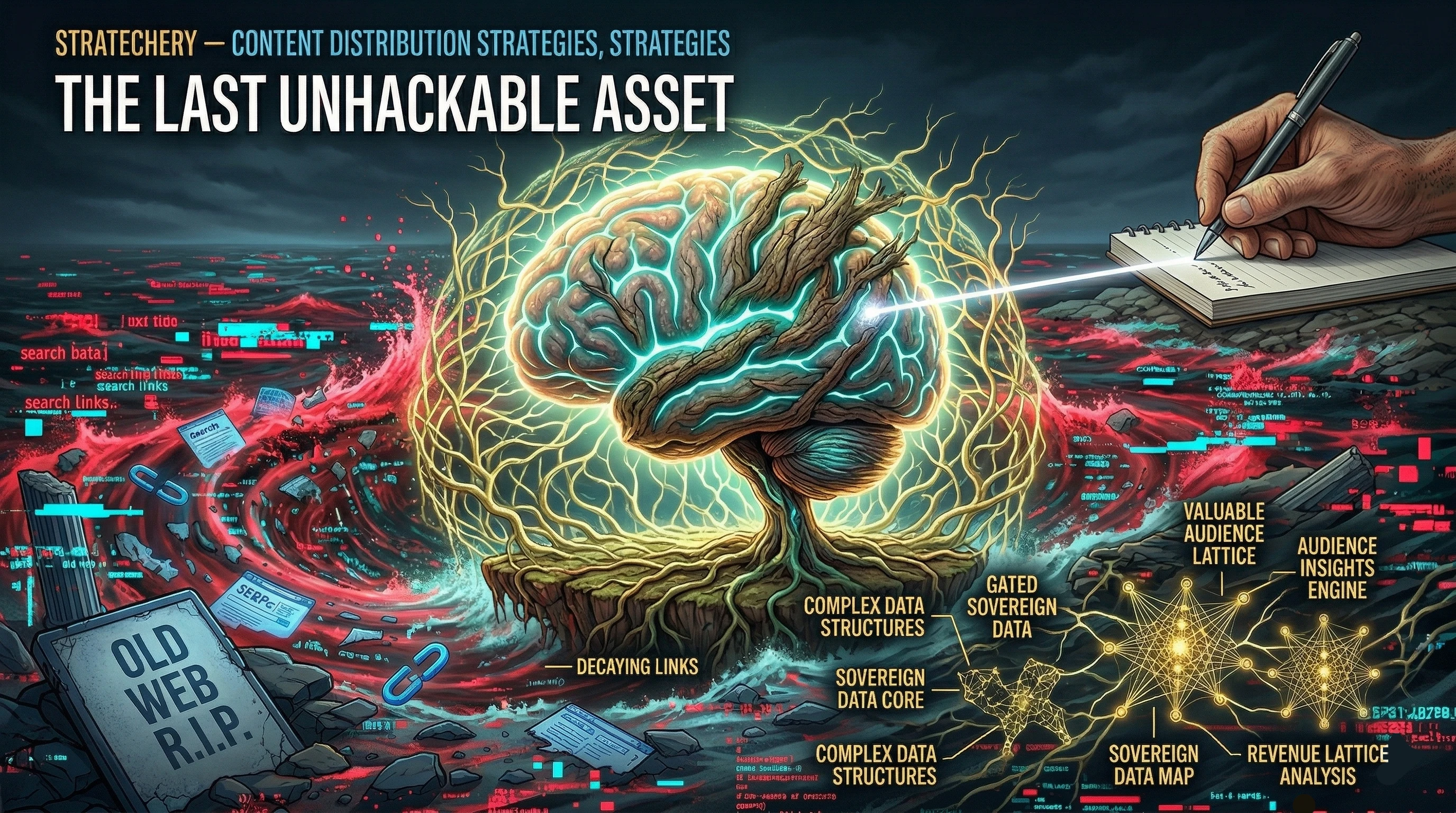
The essence of "Direct-to-Brain" is a form of Cognitive Asymmetry. It bypasses search engine filters and social media feeds entirely. It is a seed that vaults over digital walls to land directly in the neural soil of the reader. In 2026, this manifests as hyper-private, personality-driven Newsletters (Substack) or Closed-Loop Podcasts.
·The Physical Trust Fingerprint: This content carries "impurities" that algorithms cannot simulate—the author’s genuine eccentricities, their raw biases, and even their "untimely" sense of humor. These impurities are the only credentials a reader’s digital immune system recognizes to identify a "kindred spirit."
·The Uninterrupted Circuit: When you subscribe to a sovereign newsletter, you establish a consensus-based, peer-to-peer contract. This contract exists within your shared cognitive history. Any algorithm attempting to intercept or forge this connection will fail because it cannot simulate long-term Emotional Inertia.
03. The Return to Nature: Building "Knowledge Mycelium"
In 2026, top-tier creators no longer chase "reach"; they chase "Root Depth."
This mirrors the Mycorrhizal Networks in primordial forests—the "Wood Wide Web" where trees exchange information and nutrients via underground fungal networks. This exchange is physical, decentralized, and self-healing.
A "Direct-to-Brain" content strategy involves building these mycelial networks in the digital desert:
1.Decoupling from the Open Web: Reduce exposure on public social platforms to protect your "Data Sovereignty." Stop feeding the models your real-time behavioral fingerprints.
2.Establishing Private Nodes: Use "low-frequency but high-energy" channels—encrypted email or gated communities—to build direct physical connections with your audience.
3.Reinforcing Sensory Provenance: As the world becomes more digitized, increase the "Realism"—scans of handwritten notes, audio with ambient background noise, or physical handshakes. These are the "unhackable" truths of the physical world.
04.Conclusion: The Final Digital Asylum
When the 2026 internet is fully algorithmic, the only thing that will be real is the voice that causes a genuine tremor in your cerebral cortex.
"Direct-to-Brain" content is not a technology; it is a Survival Strategy. It requires us to guard our communication channels as we would guard a water source—ensuring they remain unpolluted by intermediaries. At the end of that channel is not just a customer, but your final sovereignty of expression in a silicon age.
In this noisy ruin, the only asset left is the "signal" that only you and your readers can decode.
Transparency Disclosure: Content here is for informational guidance. This publication maintains editorial independence, though some links may generate affiliate revenue. For copyright inquiries or content removal, please reach out to our desk.