On June 5, 2026, a massive infrastructure deal crossed the wire that recontextualizes the entire macroeconomic playing field. SpaceX officially signed a staggering $920 million-per-month artificial intelligence compute lease with Google. Simultaneously, details emerged of a parallel $1.25 billion-per-month agreement with Anthropic. Together, these transactions catapult SpaceX’s compute leasing revenue to an unprecedented $26 billion annual run rate.
If anyone was still wondering why Elon Musk has been quietly assembling monolithic infrastructure under various corporate umbrellas, the answer is now glaringly obvious. The space race is no longer just about rockets and satellites; it has become an infrastructure play to solve the ultimate bottleneck of human intelligence.
01. The Memphis Pivot: Turning Surplus Silicon into a Sovereign Moat
To understand how a rocket company suddenly became the most lucrative landlord in the AI ecosystem, you have to look back at the chaotic scramble for hardware that defined the early part of this decade.
The bedrock of these new agreements sits squarely on the Colossus graphics processing unit (GPU) cluster in Memphis. Originally spun up to power xAI’s Grok, the Memphis facility was envisioned as a localized crucible for brute-force reasoning. But as the sheer scale of the cluster expanded, it ran into the classic operational realities of modern tech deployment.
Elon Musk himself recently quipped about the sheer scale of managing this infrastructure, noting with characteristic bluntness that when it comes to navigating these scaling challenges, “hardware is hard.”
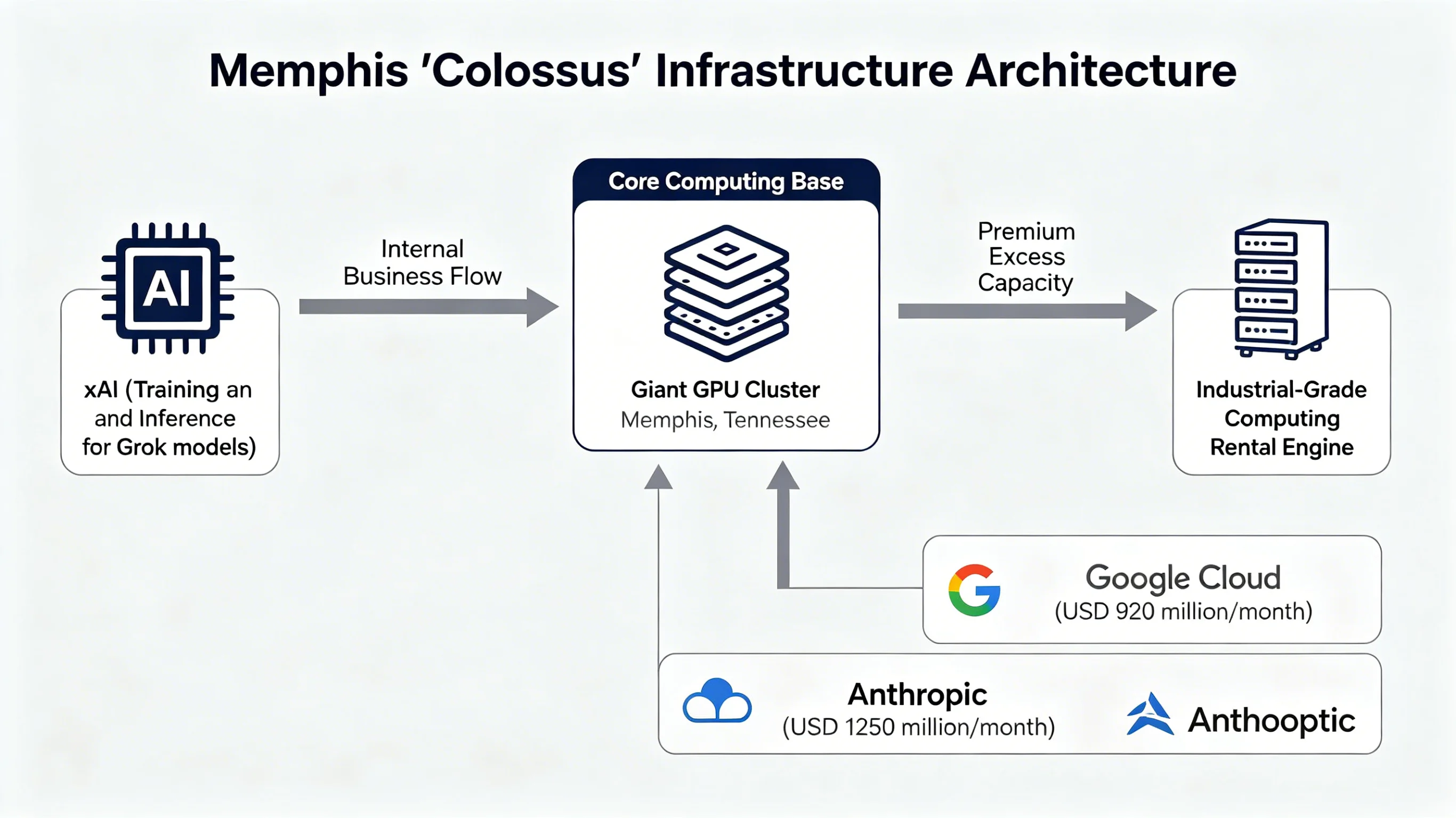 However, that exact hardship has yielded a massive structural advantage. By over-provisioning the Memphis cluster to ensure Grok’s competitive edge, Musk’s ecosystem accidentally created the largest concentration of idle, high-density compute on the planet. As terrestrial grids across Virginia, Ireland, and Frankfurt began shutting down new data center permits due to power constraints, Google and Anthropic found themselves starved for immediate, raw matrix-multiplication capacity.
By turning the excess capacity of Colossus into an industrial lease-back engine, SpaceX has executed a masterful financial arbitrage. The June 5 agreement with Google doesn’t just inject near-term liquidity; it specifically structures escalating payments stretching through October 2029.
This turns a capital-intensive hardware liability into a predictable, long-term software-like revenue stream. For Google and Anthropic, paying a premium to tap into an existing, live gigawatt-scale cluster is a survival mechanism. For SpaceX, it is the ultimate monetization of surplus silicon.
02. The Spatial Infrastructure Arbitrage: Why Google and Anthropic Paid the Premium
The sheer financial scale of these deals—pushing toward a $26 billion annual run rate—has sent shockwaves through traditional Wall Street valuation models. Why would Google, an organization that pioneered its own Tensor Processing Units (TPUs) and owns some of the largest data networks in existence, write a monthly check of nearly a billion dollars to a direct competitor's sister company?
The answer lies in what systems architects call Spatial Infrastructure Arbitrage.
In the current landscape of AI development, training a model is no longer the main expense; the real cost is inference at scale. When millions of autonomous agents are executing continuous, multi-turn reasoning steps simultaneously, the physical latency of data transit becomes a financial bottleneck. Light traveling through traditional terrestrial fiber-optic cables buried in dirt or laid across ocean floors is slowed down by the physical properties of glass.
By anchoring their foundational models onto infrastructure directly tied to SpaceX’s broader ecosystem, hyper-scalers aren't just buying GPU time; they are positioning their models to plug directly into an off-grid network. Light travels roughly 47% faster through the vacuum of space than it does through terrestrial fiber.
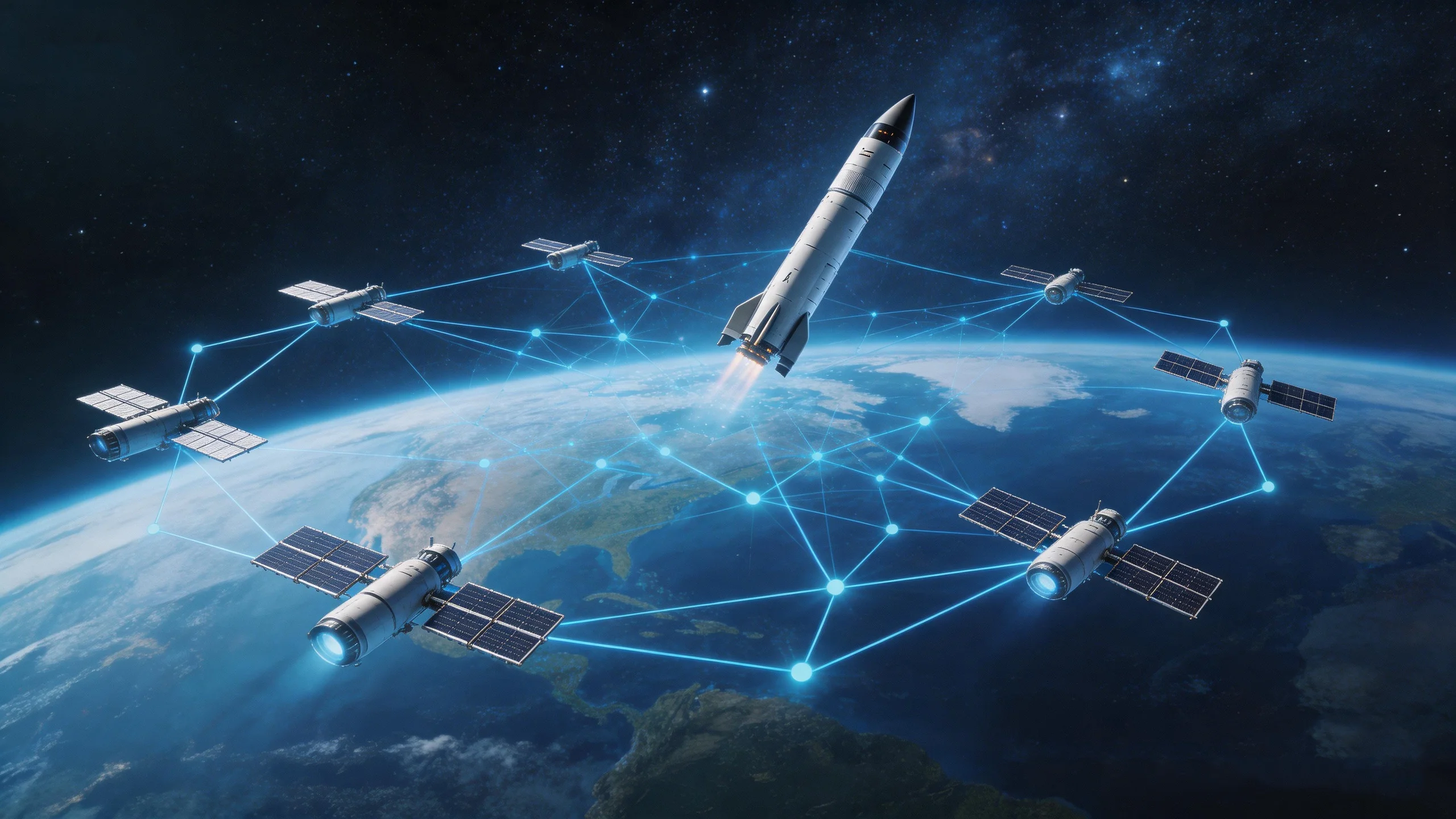
By linking the Memphis Colossus cluster with orbital communications nodes, data can be processed at the edge, routed through space via laser inter-satellite links (ISLs), and beamed down to end-users with a latency profile that terrestrial networks cannot physically match. For high-frequency trading algorithms, sovereign intelligence streams, and real-time enterprise automation, that fraction of a second is an unbeatable competitive moat. Google and Anthropic aren't just renting hardware; they are buying a ticket onto a completely independent, off-planet digital nervous system.
03. The Community and Expert Take: Pre-IPO Maneuvers and the "Skynet" Realism
Unsurprisingly, the scale of this transaction has ignited intense debate across financial forums and technical communities like Hacker News and X. Traditional aerospace analysts are trying to reconcile how a company built around rocket telemetry is suddenly out-revenueing major enterprise software firms before even executing its highly anticipated initial public offering (IPO).
On Wall Street, the consensus is that this move completely rewrites the valuation metrics for SpaceX ahead of its public market debut. By proving it can generate tens of billions in pure infrastructure leasing revenue independent of government launch contracts or consumer Starlink subscriptions, SpaceX has transformed itself in the eyes of institutional investors from a high-risk aerospace gamble into a foundational utility of the modern cognitive economy.
However, down in the developer trenches, the reaction is laced with a distinct sense of cyberpunk realism. One trending commentary on Hacker News summarized the collective unease of the engineering community:
"For years, we joked about Elon building the physical components of Skynet with Starlink and Tesla. But this June 5 deal makes it explicit. When you have Google and Anthropic—two of the three pillars of the foundational AI world—dependent on SpaceX’s hardware architecture just to run their daily inference loads, you no longer have an open internet.
You have a centralized, nuclear-adjacent computing monopoly that floats above national borders. If the Memphis cluster experiences a localized grid failure or a political dispute stalls the lease, a massive percentage of the world’s autonomous AI agents instantly go dark. The physical reality of AI has completely detached from the idealistic software layer."
Other independent developers have pointed out the absolute irony of the situation: Google, the company that practically invented the modern transformer architecture, is now forced to pay rent to a rocket company just to have enough silicon to run its own models. It highlights a brutal shift in power dynamics: in the AI era, owning the algorithms is no longer enough; survival belongs exclusively to those who control the raw, physical infrastructure.
04. The Post-Terrestrial Tech Paradigm
As the ink dries on the June 5 agreements, the tech sector is looking at a completely altered landscape. The integration of SpaceX's infrastructure with the world’s leading AI models signals that the industry has officially moved past the experimental phase of prompt engineering and entered the era of brute-force physical scaling.
Over the next few years, the line between aerospace, telecommunications, and artificial intelligence will blur into nonexistence. We are moving toward a paradigm where computing architecture is no longer anchored to a specific warehouse in Virginia or Oregon. Instead, as these multi-billion-dollar leases fund further infrastructure expansions, we will likely see the birth of fully integrated orbital data centers—silicon arrays powered by unmitigated solar radiation in the cold vacuum of space, routing tokens via laser links directly to the edge.
The traditional definition of a tech monopoly has been shattered. The new geopolitical high ground belongs to the entities that can navigate the grueling, capital-intensive reality of scaling physical hardware under the pressures of an energy-starved planet.
Yet, as this $26 billion compute engine roars into motion, it leaves the global market with an open-ended question that no algorithm can yet solve:
When the core cognitive infrastructure of human civilization is concentrated within a single, privately controlled ecosystem that bridges the earth and the sky, have we built an unshakeable foundation for the future of intelligence—or have we simply handed the keys to our digital destiny to an untouchable corporate empire floating just beyond our legal reach?
The answer is no longer a theoretical debate for tech ethicists; it is being calculated second by second, token by token, across the humming silicon valleys of Memphis and the silent vacuum above our heads. How the market adapts to this new off-world reality remains the ultimate wildcard of the decade.
Transparency Disclosure: Content here is for informational guidance. This publication maintains editorial independence, though some links may generate affiliate revenue. For copyright inquiries or content removal, please reach out to our desk.