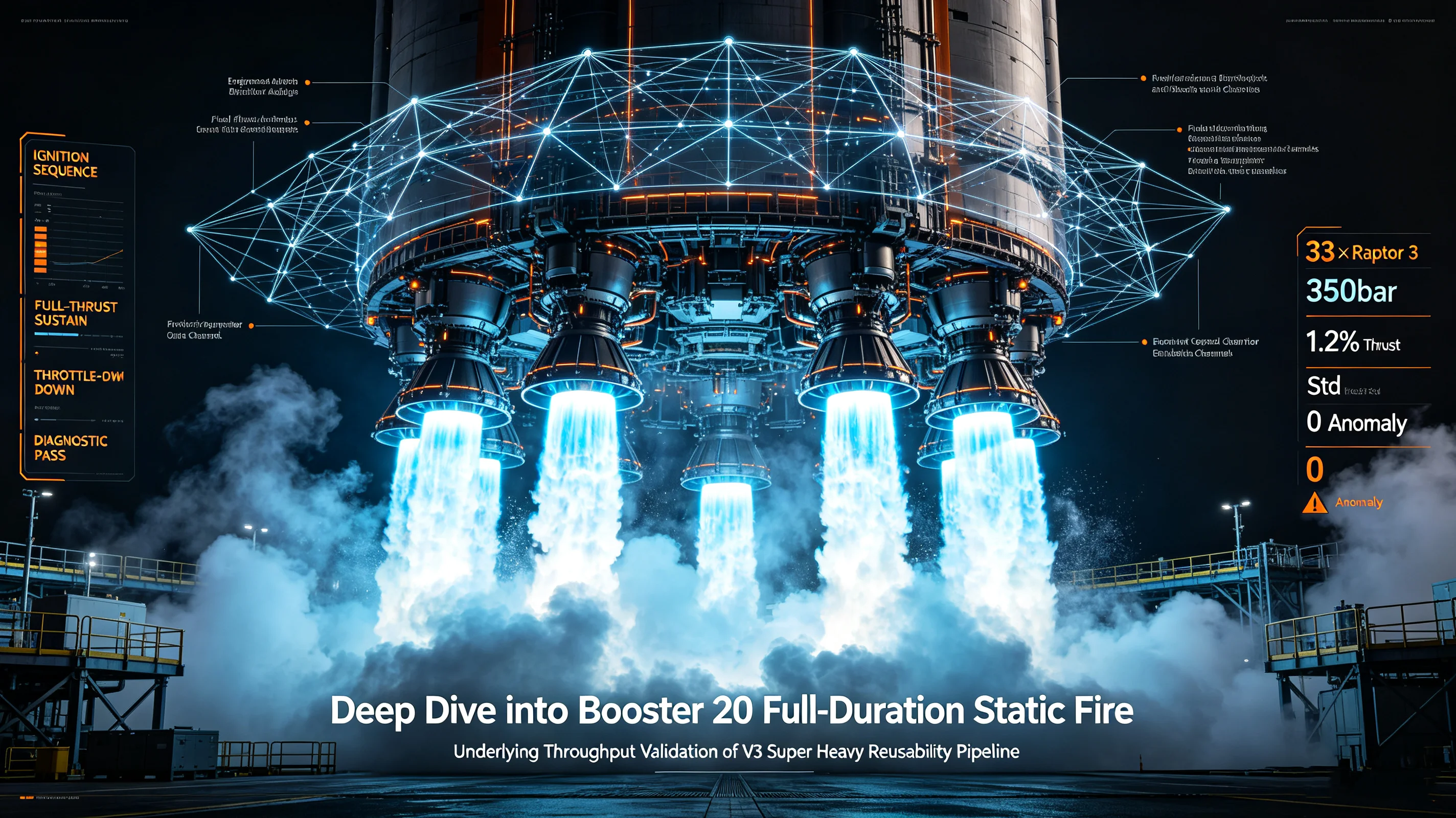
On June 12, SpaceX will execute its long-anticipated initial public offering on the Nasdaq under the ticker symbol SPCX. The architecture of the transaction is staggering: a fixed clearing price of $135 per share, an initial market capitalization of $1.77 trillion, and an aggregate capital raise of $75 billion. It represents the largest singular liquidity event in the history of global capital markets.
While the mainstream press obsesses over the sheer velocity of the wealth creation—tracking Elon Musk's trajectory toward becoming the planet's first textbook trillionaire—macroeconomic operators are looking at a much deeper structural transformation.
This is not a traditional corporate flotation; it is a live demonstration of how heavy industrial infrastructure can be leveraged to achieve absolute market enclosure. For the global professional class, the SPCX listing offers a crucial diagnostic tool for understanding where capital, power, and equity value will concentrate over the next quarter-century.
01. Generative Capital: The Inter-Enterprise Loop Driving the $1.77T Valuation
To accurately assess SpaceX's $1.77 trillion valuation, one must abandon standard equity valuation models. The company cannot be evaluated as an aerospace manufacturer or a telecom provider. Instead, it operates as the industrial core of an inter-linked, multi-enterprise network that practices what systems engineers call Generative Capital Allocation.
Musk’s core economic advantage lies in his rejection of localized optimization. Every enterprise under his control is engineered to consume the operational externalities of the others.
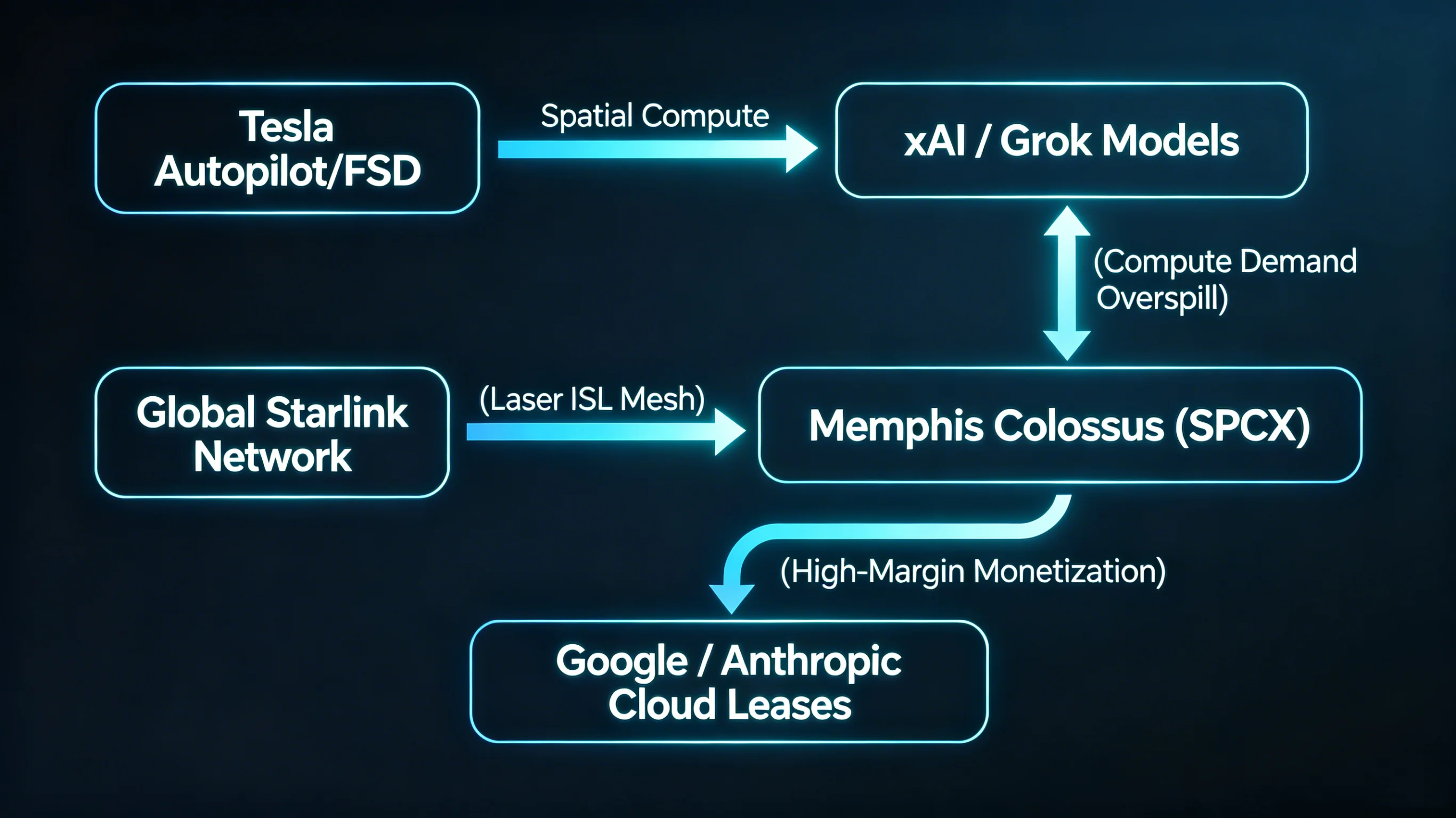 Consider the sequence: Tesla’s Full Self-Driving (FSD) localization stack laid the foundation for high-density spatial compute. This compute stack was subsequently ingested by xAI to train its Grok models. The massive, immediate training and inference demands of xAI compelled SpaceX to over-provision its physical infrastructure, resulting in the construction of the massive "Colossus" GPU cluster in Memphis.
When the broader terrestrial AI sector hit an energy wall due to grid lockouts in Northern Virginia and Frankfurt, SpaceX simply pivoted its idle, over-provisioned infrastructure outward. By locking in long-term, high-margin compute leases with Google ($920 million/month) and Anthropic ($1.25 billion/month), SpaceX successfully converted a capital-intensive hardware footprint into a highly predictable, software-like revenue engine.
The $1.77 trillion valuation is the direct market acknowledgment of this closed-loop ecosystem. The company has insulated itself from the standard dependencies of the macroeconomic cycle by becoming the foundational utility provider for the next generation of machine intelligence.
02. Institutional Asymmetry: Equity Distribution and the Labor Arbitrage Counter-Narrative
The filing reveals that the SPCX listing will instantly mint an estimated 4,000 new millionaires within the company’s internal ranks. The geographic and cultural distribution of this equity windfall provides a fascinating case study in organizational architecture and corporate retention.
The wealth concentration is uniquely decentralized. The beneficiaries are not merely senior product directors or machine learning researchers based in Palo Alto or Austin; they are specialized materials welders at the Starbase launch facility in Boca Chica, production technicians assembling Merlin and Raptor engines in Hawthorne, and basic administrative staff supporting the logistical supply chains.
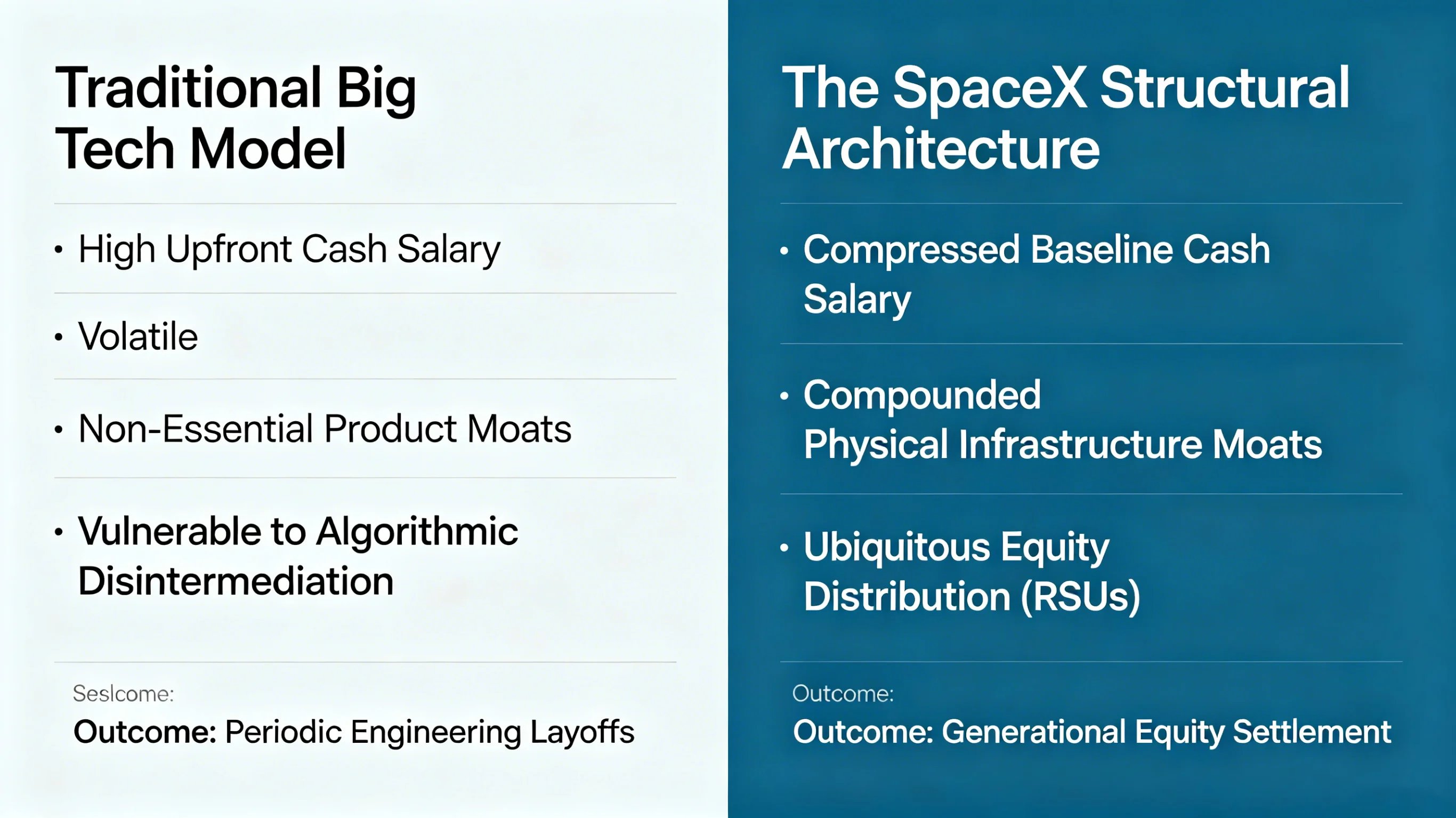 This structural outcome offers an essential blueprint for modern organizational design. Throughout its development, SpaceX deliberately suppressed baseline cash compensation relative to legacy tech monopolies. Instead, it utilized a high-distribution framework of Restricted Stock Units (RSUs) tied to tangible physical milestones.
In an era where digital knowledge workers are facing widespread displacement due to automated code generation and algorithmic disintermediation, SpaceX established an unshakeable labor defense: it tethered its human capital to hard, heavy physical infrastructure. A software script cannot weld an aerospace-grade tank section or navigate the regulatory complexities of a dual-use orbital launch platform. By aligning its workforce with physical moats and rewarding them with structural equity, the organization has demonstrated that the ultimate yield on long-term industrial risk belongs to those who build the physical world.
03. The Bear Case from the Floor: Retail Ingestion and the capex Void
However, a cold analytical reading of the S-1 prospectus requires looking past the institutional euphoria. A valuation of this magnitude demands flawless operational execution within an incredibly volatile environment.
A primary structural anomaly within the listing architecture is SpaceX’s decision to allocate up to 30% of its total IPO tranche directly to retail distribution platforms like Robinhood and Fidelity. While legacy financial commentators are framing this as a democratization of space equity, institutional short-sellers and quantitative analysts are reading it as a highly calculated maneuver to capture non-institutional liquidity.
The underlying financials reveal an incredibly high rate of capital consumption. While Starlink’s commercial enterprise business remains a highly lucrative cash-generation engine, the development costs associated with the Starship program and the massive deployment of on-orbit data processing clusters require continuous, intensive capital expenditure.
By bypassing traditional institutional price discovery and fixing the debut at $135 per share via retail networks, the company is effectively utilizing public market enthusiasm to insulate early private venture allocators. The long-term performance of SPCX will depend entirely on whether Starlink’s global enterprise subscription margins can scale fast enough to offset the constant, multi-billion-dollar infrastructure burn rate of its deep-space programs before institutional lock-up periods expire.
04. Strategic Horizon: The De-Territorialization of Global Compute
As the market prepares for the June 12 opening bell, the broader tech landscape is entering a fundamentally de-territorialized era. The convergence of SpaceX’s physical launch infrastructure with the computational dependencies of global AI models indicates that the tech industry has permanently moved past the era of pure-play software engineering.
We are moving rapidly toward a paradigm where sovereignty, computing power, and asset security are no longer bounded by terrestrial geography. The massive influx of public capital from this IPO will directly finance the next stage of the orbital computing layer—establishing automated, liquid-cooled silicon nodes running on unmitigated solar radiation in the vacuum of space, completely decoupled from local state regulations, real estate limits, and terrestrial grid vulnerabilities.
The definition of a market monopoly has been entirely rewritten. Systemic power no longer belongs to those who control the digital interface; it belongs exclusively to the operators who possess the physical, energy-independent infrastructure required to sustain the computational needs of a planetary economy.
As this $1.77 trillion capital engine integrates with the public markets, it presents every modern professional and investor with a profound structural question:
As institutional capital and computational assets migrate away from terrestrial constraints and into decentralized, off-planet networks, what portion of your personal asset architecture is insulated from the systemic vulnerabilities of the land-based economy? Have you structured your capital and skills to survive a landscape where the core utilities of global commerce operate completely beyond the jurisdiction of traditional state regulation?
The resolution to this epochal transformation will not be found in conventional market commentary. It is being written in real-time by the automated execution of multi-billion-dollar infrastructure loops, moving silently through the upper atmosphere at the speed of light. The market is about to open, and the gravity well is shifting.
Transparency Disclosure: Content here is for informational guidance. This publication maintains editorial independence, though some links may generate affiliate revenue. For copyright inquiries or content removal, please reach out to our desk.