To be honest, every time I scroll past those viral "hardcore weekend itineraries" on social media, I just feel exhausted. When travel is reduced to an aggressive, clock-watching race to prove "I was here," how is it any different from punch-in-punch-out factory work?
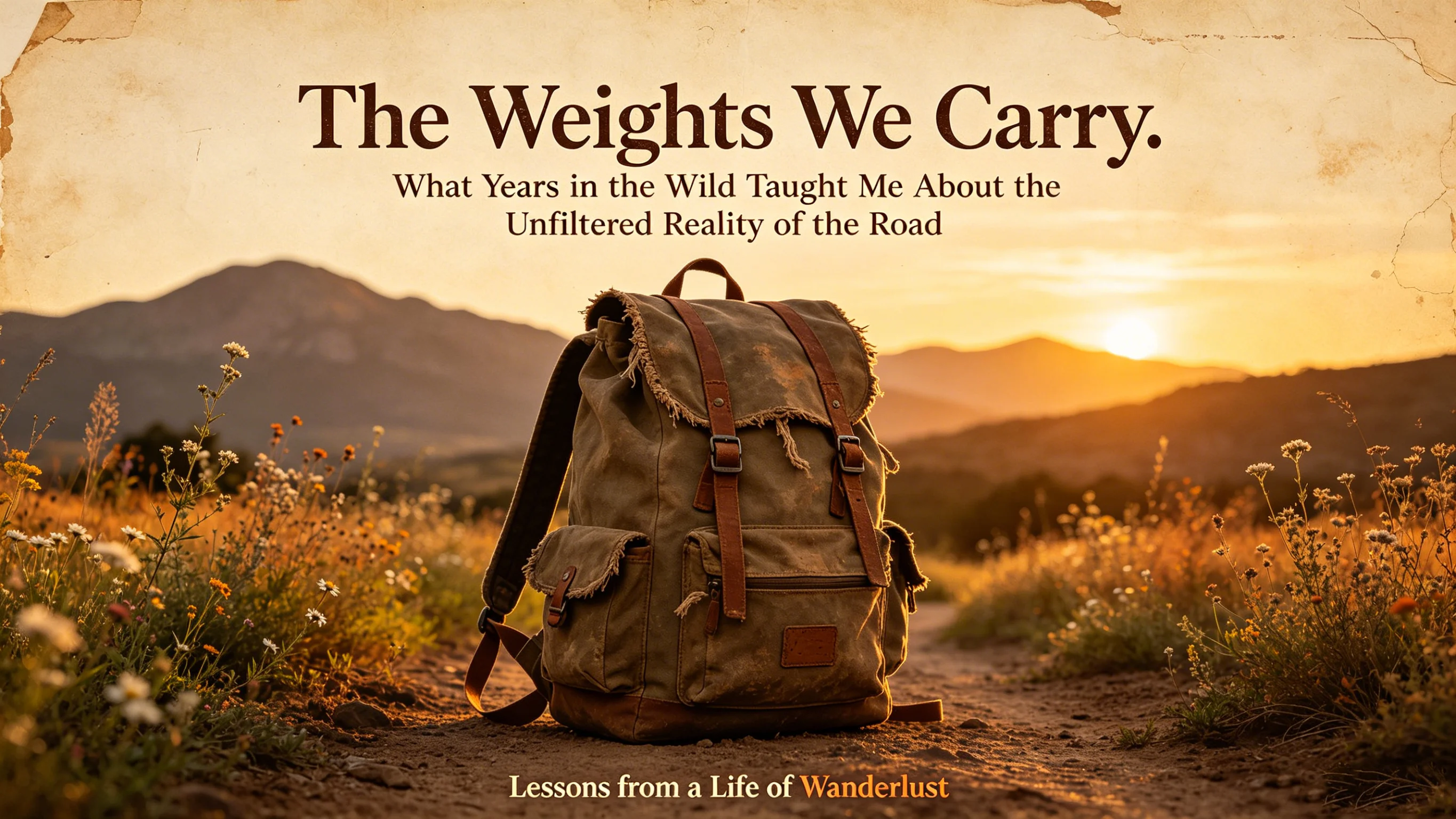
I’ve paid a lot of tuition to the road. When I first started backcountry backpacking, my anxiety dictated my packing. I felt that carrying absolutely everything was the only way to be safe. I once hauled a fifty-pound pack onto a high-altitude trek, stuffed with three spare outfits, four power banks, two extra pairs of shoes, and even a heavy hardcover book I foolishly thought would look "poetic" to read under a glacier.
The reality? The moment the altitude crossed 13,000 feet, every single step felt like a demon was dragging me back by the throat. By day three, even carrying an extra pack of tissues felt like a sin, and I genuinely contemplated burning that book just to cook my dinner.
That was when I realized a fundamental truth: the weight of your pack is simply the physical manifestation of your fears. The more gear you pack, the less confidence you have in your own capacity to handle the journey.
These days, for any trek under seven days, my pack never exceeds twelve kilograms (26 lbs). Aside from a couple of reliable merino wool shirts and a hard-shell jacket, I bring two pairs of underwear and socks. At night in the tent, I rinse one pair using the leftover warm water from my thermos, hang it on the back of my pack the next morning, and let the sun and wind dry it while I hike. And leave those heavy, stiff leather boots at home if you're on a established trail; a pair of lightweight trail running shoes with an aggressive tread will save you half your physical energy.
The same ethos applies to food. Those pristine outdoor influencers searing ribeyes and brewing artisanal pour-overs against a snowy mountain backdrop are putting on a show for city folks. On a real, grueling wilderness route, every single gram of weight is aggressively calculated.
Our core rations are always high-calorie, low-weight, and zero-fuss. Compression biscuits are strictly for emergency survival—eating them routinely will choke you dry. If you look into a veteran hiker's pack, the most prominent space is always occupied by Snickers bars, mixed nuts, instant oatmeal, and a few packs of incredibly salty dehydrated pickles. At high altitudes, dehydration and sodium depletion can cause your body to collapse instantly. In those moments, a packet of cheap pickles paired with a bowl of half-cooked rice is absolute heaven. Always carry electrolyte tablets too; glacier melt looks pristine, but it’s essentially distilled water devoid of minerals. Drink it straight for too long and your legs will turn to jelly.
When it comes to route-finding, modern tech has made us lazy. Everyone blindly follows downloaded GPS tracks on apps like AllTrails or Gaia. While this mitigates 90% of the danger, blindly worshiping a digital line can get you killed.
The wilderness changes instantly. A while back in the high plateaus, I was following a perfect GPS track uploaded by a hiker just six months prior. When I arrived on-site, a massive landslide from a recent storm had completely obliterated the valley trail, replacing it with a forty-foot vertical drop. If I had mindlessly followed that digital line forward, I would have walked straight off a cliff.
That is where old-school instinct comes in. You have to learn to read the topology of the terrain. Deep valleys sandwiched between two steep peaks might look like intuitive, sheltered pathways, but they are actually natural funnels for rockfalls and flash floods—the absolute worst place to linger. Conversely, ridges—while brutally windy—offer visibility and are entirely safe from falling debris. If you get turned around, follow the water. In almost any geography, walking downstream will eventually lead you back to human civilization. Just walk alongside the stream, never directly on the loose river rocks; that is a textbook recipe for a sprained ankle, which in the wild, is functionally equivalent to a broken leg.
Dealing with remote communities requires an entirely different layer of psychological nuance.
In deep, isolated regions, you will frequently encounter villages where not a soul speaks your language. If you walk in shouting tourist phrases, they will just stare at you with cold suspicion. In these moments, your most effective communication tools are your eyes and your posture.
Before crossing the threshold of someone’s property—even if there is no fence—never just barge in. Stand outside the perimeter, call out loudly, and wait patiently for the owner (or their dog) to acknowledge you. When the host steps out, pull your hands out of your pockets and hold them slightly open, palms up. This gesture is universally understood across human history and the animal kingdom: it means "My hands are empty; I am not a threat."
If you need a place to sleep, don't immediately whip out your wallet. Flashing cash makes it feel like a transactional transaction, which can be deeply offensive to cultures rooted in hospitality. Instead, explain through gestures that you are exhausted and simply ask for a cup of water. Sit down, drink their tea, let the atmosphere warm up, and share whatever snacks you have with the children. Only then should you inquire if it's possible to roll out your sleeping pad on their floor. When you leave the next morning, quietly tuck the accommodation money under a teacup. That is how you navigate human connection on the road.
Finally, let's talk about something slightly esoteric but entirely real: the gut instinct.
In the wild, your biology will often detect danger before your rational brain does. I’ve had several instances where I picked out a seemingly perfect, flat, sheltered grassy patch to pitch my tent. But as I sat down to unpack, a sudden, inexplicable wave of unease hit me—the hairs on the back of my neck stood up for no apparent reason. I didn't question it. I packed up immediately and hiked another thirty minutes up a brutal, wind-scoured scree slope to camp on exposed rock. That exact night, an upstream glacial pocket burst, and the pristine grassy patch I had initially chosen was buried under four feet of rushing water and mud by 2:00 AM.
In the face of nature, modern human logic is laughably fragile. Never gamble on that 1% chance of luck. The moment the sky darkens and the cloud deck begins to drop, drop your ego and establish a safe camp immediately, regardless of how close you are to your intended destination. In the mountains, darkness and hypothermia amplify every obstacle tenfold. It is infinitely better to endure a miserable but safe night in a makeshift camp than to navigate unknown mountain terrain in the dark.
Ultimately, deep travel is an act of throwing your fragile, city-slicker self into the furnace of the natural world to be re-tempered.
In the city, you are conditioned to believe the world is entirely subservient to you, with its predictable subways, climate-controlled apartments, and on-demand food delivery. But out here, the rain will drench you to the bone, the wind will rip your tent stakes from the earth, and altitude sickness will make your skull feel like it's cracking open. Stripped of your brand-name clothing and societal titles, you realize you are no different from your ancestors who ran across these same barren plains millennia ago.
But it is precisely this raw, unyielding unpredictability that burns away the sticky, suffocating anxieties and mental noise of modern urban life. When you finally scramble onto the high pass with bleeding hands, watching the cold moonlight illuminate a massive, silent pyramid of ice while the wind roars in your ears, you realize one thing with absolute clarity: to be alive in a world this fierce is an absolute privilege.To be honest, every time I scroll past those viral "hardcore weekend itineraries" on social media, I just feel exhausted. When travel is reduced to an aggressive, clock-watching race to prove "I was here," how is it any different from punch-in-punch-out factory work?
I’ve paid a lot of tuition to the road. When I first started backcountry backpacking, my anxiety dictated my packing. I felt that carrying absolutely everything was the only way to be safe. I once hauled a fifty-pound pack onto a high-altitude trek, stuffed with three spare outfits, four power banks, two extra pairs of shoes, and even a heavy hardcover book I foolishly thought would look "poetic" to read under a glacier.
The reality? The moment the altitude crossed 13,000 feet, every single step felt like a demon was dragging me back by the throat. By day three, even carrying an extra pack of tissues felt like a sin, and I genuinely contemplated burning that book just to cook my dinner.
That was when I realized a fundamental truth: the weight of your pack is simply the physical manifestation of your fears. The more gear you pack, the less confidence you have in your own capacity to handle the journey.
These days, for any trek under seven days, my pack never exceeds twelve kilograms (26 lbs). Aside from a couple of reliable merino wool shirts and a hard-shell jacket, I bring two pairs of underwear and socks. At night in the tent, I rinse one pair using the leftover warm water from my thermos, hang it on the back of my pack the next morning, and let the sun and wind dry it while I hike. And leave those heavy, stiff leather boots at home if you're on a established trail; a pair of lightweight trail running shoes with an aggressive tread will save you half your physical energy.
The same ethos applies to food. Those pristine outdoor influencers searing ribeyes and brewing artisanal pour-overs against a snowy mountain backdrop are putting on a show for city folks. On a real, grueling wilderness route, every single gram of weight is aggressively calculated.
Our core rations are always high-calorie, low-weight, and zero-fuss. Compression biscuits are strictly for emergency survival—eating them routinely will choke you dry. If you look into a veteran hiker's pack, the most prominent space is always occupied by Snickers bars, mixed nuts, instant oatmeal, and a few packs of incredibly salty dehydrated pickles. At high altitudes, dehydration and sodium depletion can cause your body to collapse instantly. In those moments, a packet of cheap pickles paired with a bowl of half-cooked rice is absolute heaven. Always carry electrolyte tablets too; glacier melt looks pristine, but it’s essentially distilled water devoid of minerals. Drink it straight for too long and your legs will turn to jelly.
When it comes to route-finding, modern tech has made us lazy. Everyone blindly follows downloaded GPS tracks on apps like AllTrails or Gaia. While this mitigates 90% of the danger, blindly worshiping a digital line can get you killed.
The wilderness changes instantly. A while back in the high plateaus, I was following a perfect GPS track uploaded by a hiker just six months prior. When I arrived on-site, a massive landslide from a recent storm had completely obliterated the valley trail, replacing it with a forty-foot vertical drop. If I had mindlessly followed that digital line forward, I would have walked straight off a cliff.
That is where old-school instinct comes in. You have to learn to read the topology of the terrain. Deep valleys sandwiched between two steep peaks might look like intuitive, sheltered pathways, but they are actually natural funnels for rockfalls and flash floods—the absolute worst place to linger. Conversely, ridges—while brutally windy—offer visibility and are entirely safe from falling debris. If you get turned around, follow the water. In almost any geography, walking downstream will eventually lead you back to human civilization. Just walk alongside the stream, never directly on the loose river rocks; that is a textbook recipe for a sprained ankle, which in the wild, is functionally equivalent to a broken leg.
Dealing with remote communities requires an entirely different layer of psychological nuance.
In deep, isolated regions, you will frequently encounter villages where not a soul speaks your language. If you walk in shouting tourist phrases, they will just stare at you with cold suspicion. In these moments, your most effective communication tools are your eyes and your posture.
Before crossing the threshold of someone’s property—even if there is no fence—never just barge in. Stand outside the perimeter, call out loudly, and wait patiently for the owner (or their dog) to acknowledge you. When the host steps out, pull your hands out of your pockets and hold them slightly open, palms up. This gesture is universally understood across human history and the animal kingdom: it means "My hands are empty; I am not a threat."
If you need a place to sleep, don't immediately whip out your wallet. Flashing cash makes it feel like a transactional transaction, which can be deeply offensive to cultures rooted in hospitality. Instead, explain through gestures that you are exhausted and simply ask for a cup of water. Sit down, drink their tea, let the atmosphere warm up, and share whatever snacks you have with the children. Only then should you inquire if it's possible to roll out your sleeping pad on their floor. When you leave the next morning, quietly tuck the accommodation money under a teacup. That is how you navigate human connection on the road.
Finally, let's talk about something slightly esoteric but entirely real: the gut instinct.
In the wild, your biology will often detect danger before your rational brain does. I’ve had several instances where I picked out a seemingly perfect, flat, sheltered grassy patch to pitch my tent. But as I sat down to unpack, a sudden, inexplicable wave of unease hit me—the hairs on the back of my neck stood up for no apparent reason. I didn't question it. I packed up immediately and hiked another thirty minutes up a brutal, wind-scoured scree slope to camp on exposed rock. That exact night, an upstream glacial pocket burst, and the pristine grassy patch I had initially chosen was buried under four feet of rushing water and mud by 2:00 AM.
In the face of nature, modern human logic is laughably fragile. Never gamble on that 1% chance of luck. The moment the sky darkens and the cloud deck begins to drop, drop your ego and establish a safe camp immediately, regardless of how close you are to your intended destination. In the mountains, darkness and hypothermia amplify every obstacle tenfold. It is infinitely better to endure a miserable but safe night in a makeshift camp than to navigate unknown mountain terrain in the dark.
Ultimately, deep travel is an act of throwing your fragile, city-slicker self into the furnace of the natural world to be re-tempered.
In the city, you are conditioned to believe the world is entirely subservient to you, with its predictable subways, climate-controlled apartments, and on-demand food delivery. But out here, the rain will drench you to the bone, the wind will rip your tent stakes from the earth, and altitude sickness will make your skull feel like it's cracking open. Stripped of your brand-name clothing and societal titles, you realize you are no different from your ancestors who ran across these same barren plains millennia ago.
But it is precisely this raw, unyielding unpredictability that burns away the sticky, suffocating anxieties and mental noise of modern urban life. When you finally scramble onto the high pass with bleeding hands, watching the cold moonlight illuminate a massive, silent pyramid of ice while the wind roars in your ears, you realize one thing with absolute clarity: to be alive in a world this fierce is an absolute privilege.
Transparency Disclosure: Content here is for informational guidance. This publication maintains editorial independence, though some links may generate affiliate revenue. For copyright inquiries or content removal, please reach out to our desk.