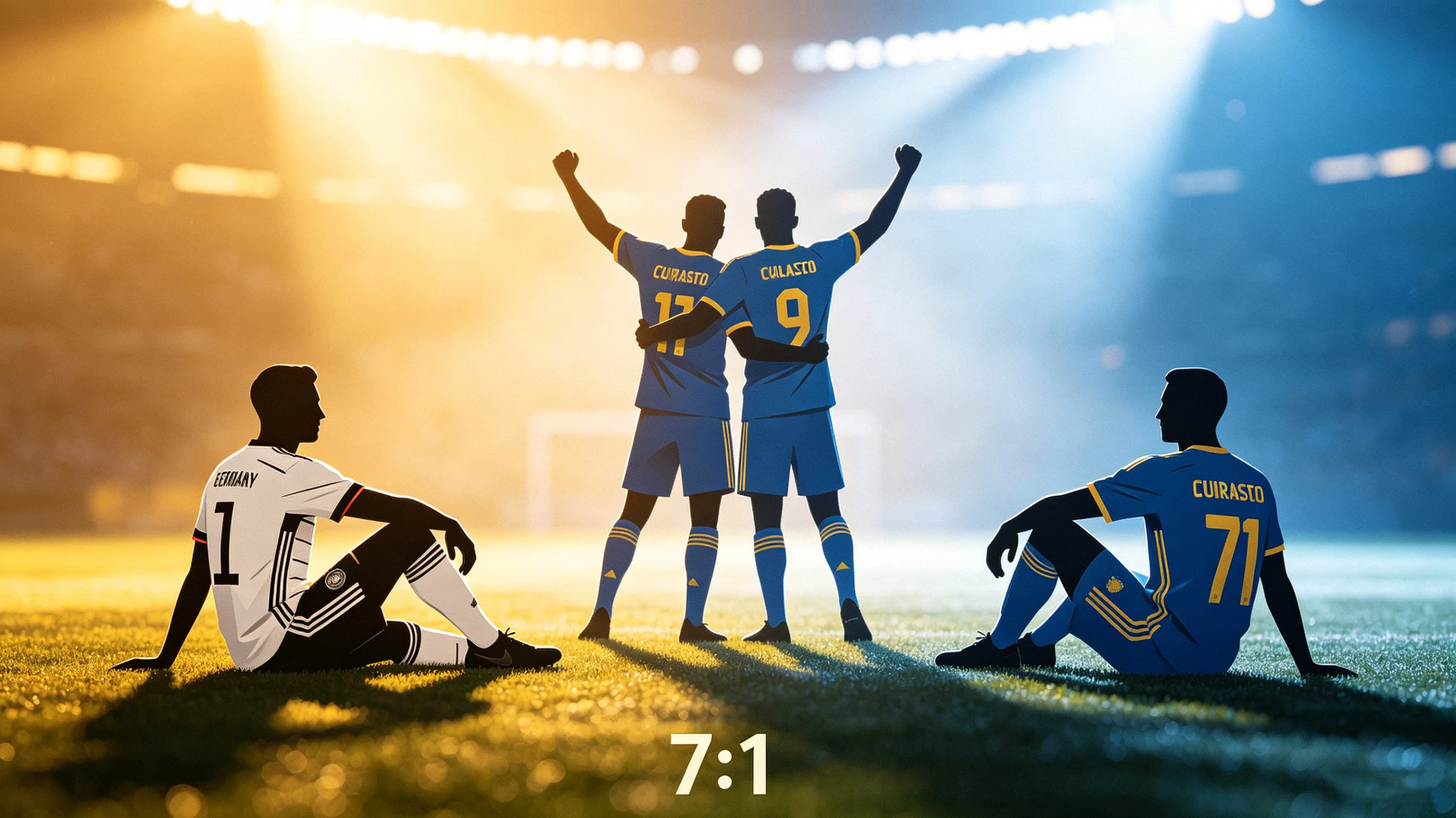
For anyone who watched the group stage match between Germany and Curaçao, the final 1-7 scoreline on the jumbotron seemed to tell a familiar story of a footballing powerhouse dismantling a minnow. But if you shut off the TV after the final whistle, you missed the entire point of the match.
As a lifelong football fan, I’ve seen my share of blowouts. Yet, this particular 90 minutes didn't feel like a routine execution. It felt like a profound reminder of why this sport captures the global imagination like nothing else on earth.
The Tears Before the Storm
The defining image of the match didn't happen during a goal celebration. It happened before a single ball was kicked.
Curaçao’s 78-year-old manager, Dick Advocaat, stood on the touchline during the national anthems with tears streaming down his face. Maybe it was just the fierce summer wind catching the eyes of an aging veteran. Or perhaps, it was the sheer weight of what he had achieved.
Curaçao is a Caribbean island with a population of under 200,000. By all logical metrics of modern sports science and infrastructure, they had no business qualifying for the world's biggest stage.
More poignantly, Advocaat almost didn't make it to the dugout. After securing their historic qualification, the legendary Dutch tactician stepped away from the team for four months to care for his daughter, who was battling cancer. He had quietly planned to retire, to stay by her side. But the players, the staff, and the entire island's football community begged him to return. They told him: "You got us here. You have to finish this journey with us."
He listened. He came back. And as he stood there facing the German giants, the emotional weight of life, survival, and football converged in those few quiet seconds before kickoff.
Seventeen Minutes of Absolute Anarchy
When the whistle blew, Germany looked every bit the industrial football machine we expect them to be. By the 5th minute, Felix Nmecha and Florian Wirtz cut through Curaçao's defense with a fluid give-and-go that looked more like a training ground drill than a high-stakes match, putting Germany up 1-0. Kai Havertz dropped deep, acting as a tactical decoy to drag defenders away and open up half-spaces for Jamal Musiala.
But then, Germany ran into a wall of pure defiance. Julian Brandt and Wirtz refused to hold the width, crowding the central corridors. Leroy Sané looked determined to cut inside on every possession, resulting in intercepted backheels, blocked shots, and frantic over-passing in a congested penalty box. Germany dominated the first half with 71% possession and registered 16 shots, but 11 of them never even tested the keeper—they were relentlessly blocked by a frantic thicket of Curaçaoan legs.
Then came the 21st minute—a moment that will be told in Caribbean pubs for the next fifty years.
Jearl Margaritha exploited a gap on Germany's right flank, kept his composure, and slotted the ball past the keeper.
1-1. Curaçao had equalized against Germany.
For the next 17 minutes, a nation of fewer than 200,000 people held a football superpower to a dead-even tie. It took a thumping 38th-minute header from Nico Schlotterbeck off a corner to finally break the deadlock and put Germany ahead 2-1. Havertz later converted a penalty to make it 3-1, essentially killing the sporting suspense before Germany ran away with a 7-1 scoreline in the second half.
But those 17 minutes? They belong to Curaçao forever. To put it in perspective, remember when China hit the post against Brazil in 2002? Imagine if that ball went in, and a squad of underdogs held Ronaldo, Rivaldo, and Ronaldinho to a draw for nearly twenty minutes. That is what this tiny island accomplished.
No Shame in a 1-7
After the match, a commentator on German television quipped a rather sharp line: "This isn't a scoreline you can just pull off against anyone. Maybe against Brazil, sure, but not against most teams."
It was a brutal, tongue-in-cheek reference to the infamous 2014 World Cup semifinal, where Germany systematically dismantled host-nation Brazil 7-1 on their own turf.
If the most decorated footballing nation in South American history can suffer an identical 1-7 humiliation at the hands of the German machine, Curaçao has absolutely nothing to be ashamed of. Havertz’s clinical brace today mirrored the legendary clinical efficiency we saw back in 2002 when Miroslav Klose announced himself to the world with a hat-trick against Saudi Arabia. Germany does this to teams. It’s what they do.
But unlike so many teams that get swallowed by the German press, Curaçao left their mark. They scored.
The Full Circle of a 32-Year Journey
There is a beautiful historical symmetry to this match that older fans will appreciate. Exactly 32 years ago, during the 1994 World Cup in the United States, a much younger Dick Advocaat led a brilliant Netherlands squad into a quarterfinal thriller against Brazil. That match became an instant classic—famed for Bebeto’s iconic "baby cradle" celebration, Romário’s lethal outside-of-the-boot finishes, and Branco’s thunderous free-kick that ultimately saw Advocaat’s Dutch side fall 2-3 to the eventual champions.
Thirty-two years later, Advocaat is no longer managing European heavyweights. He is managing a dot on the map. Yet, against a team wearing the same white shirts of a European powerhouse, he managed to engineer a tactical moment that breached the German defense.
From facing down the legendary Seleção in '94 to guiding an island nation to a historic goal in 2026, Advocaat's career has come full circle in the most poetic way possible.
The citizens of Curaçao should build a statue of Dick Advocaat outside their national stadium. The metrics of modern, hyper-optimized sports analytics will tell you this match was a statistical blowout. But for anyone who actually loves this game, the old manager's tears and those 17 minutes of a 1-1 scoreline reminded us of the only metric that matters: the pure, unadulterated heart of the underdog.
Transparency Disclosure: Content here is for informational guidance. This publication maintains editorial independence, though some links may generate affiliate revenue. For copyright inquiries or content removal, please reach out to our desk.