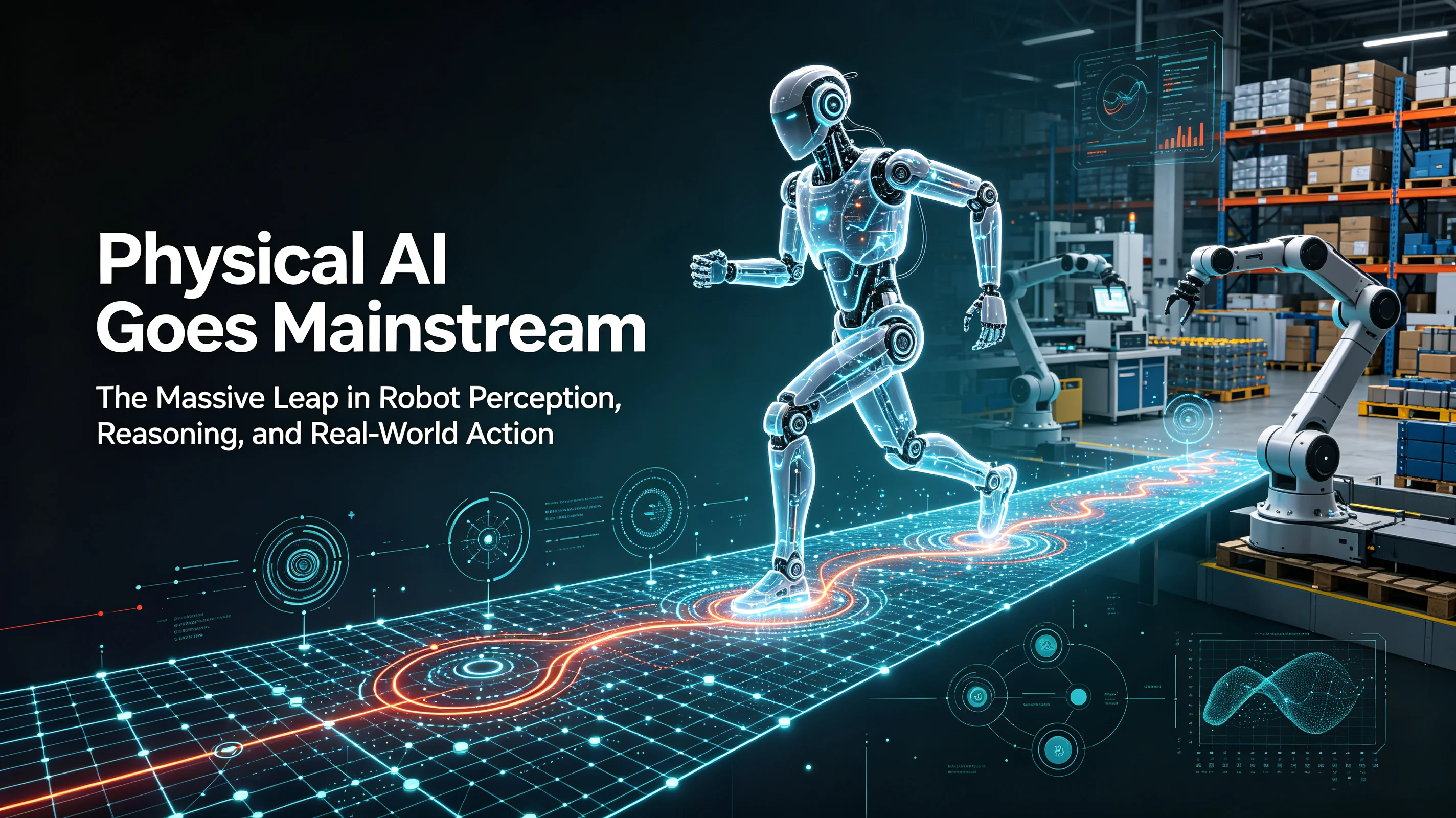
In 2026, artificial intelligence is breaking free from digital interfaces and embedding itself into the physical world. Physical AI, also widely known as embodied AI, is transforming robots from pre-programmed mechanical machines into intelligent agents capable of environmental perception, natural language understanding, logical reasoning, and autonomous action. The simultaneous breakthrough in perception, reasoning, and motor execution is pushing robotic systems out of controlled laboratory environments and into factories, warehouses, and increasingly complex real-world scenarios.
From Modular Pipelines to End-to-End Intelligence: VLA and World Models Take Over
Traditional robotic systems rely on fragmented modular architectures that separate perception, planning, and control. This disjoint workflow results in slow adaptation, rigid performance, and high deployment friction. Today, the industry is rapidly shifting toward unified Vision-Language-Action (VLA) models, streamlined end-to-end frameworks that directly process visual inputs and textual instructions to output executable robotic motion sequences.
Leading this paradigm shift are world foundation models, the next-generation backbone for physical intelligence. NVIDIA’s Cosmos 3, unveiled in 2026, stands as the flagship innovation in this field. Built on a hybrid Transformer architecture, the model integrates visual reasoning, world simulation, and action prediction within a single unified system. It inherently understands physical rules and object interaction logic, predicts future environmental states, and outputs precise low-level control signals—including robot joint angles and gripper positioning data.
Dramatic Advances in Robotic Perception and Cognitive Reasoning
On the reasoning front, AI-powered robots now exhibit deliberate “think-before-acting” cognition. Before executing physical movements, systems simulate potential outcomes, evaluate task feasibility, and optimize action strategies in advance—marking a critical departure from the reactive execution of traditional robots.
These upgrades have delivered striking real-world performance gains. Generalist’s GEN-1.5 model has boosted its success rate on mainstream robotic benchmark tasks from 64% to 99%, while accelerating task completion speed by approximately three times. Notably, the model achieves this high-level performance with merely one hour of real robotic training data.
The industry’s cutting-edge systems have even mastered one-shot visual imitation learning: they can learn entirely new tasks by analyzing just 3 to 12 seconds of demonstration footage, with no additional training or fine-tuning required. Skild AI’s S1 model further validates this capability, reliably understanding and executing complex physical tasks from a single video demonstration.
These innovations drastically cut the cost and cycle of robotic task deployment, driving a fundamental shift from scenario-specific customized robots to versatile, general-purpose intelligent systems.
Breakthrough Motor Capabilities Accelerate Industrial Adoption
Physical AI has unlocked major breakthroughs in full-body coordinated control and precise dexterous manipulation. NVIDIA’s SONIC controller translates VR motion tracking, visual footage, and natural language commands into fluid, synchronized movements for humanoid robots, eliminating the need for model retraining when switching input modalities. Similarly, Google’s Gemini Robotics 2 supports cross-hardware generalization, enabling consistent full-body and dual-arm operation across robotic platforms with diverse hand configurations.
Industrial and logistics sectors are the earliest beneficiaries of these advances. Modern robotic systems can adapt to unstructured, dynamic working environments, adjusting flexibly to workflow layout changes, new product lines, and variable operational demands without manual reprogramming.
Per McKinsey industry analysis, Physical AI has become a tangible source of economic value for manufacturing and logistics, with the potential to unlock trillion-dollar market value in the long term. Driven by massive commercial potential, global investment in Physical AI hit a record high in 2025, fueling rapid iterative upgrades and industrial validation.
Persistent Challenges and Industry Outlook
Despite explosive capability growth, large-scale commercial deployment still faces core barriers centered on reliability, safety, and cost. Key bottlenecks remain: low task success rates for long-horizon missions in unstructured environments, persistent sim-to-real gaps between virtual simulation and real-world execution, and insufficient standardized safety verification protocols.
Industry consensus suggests that fully reliable general autonomous intelligence for complex physical scenarios will not reach mature mass deployment until 2028 to 2030.
The current industry paradigm follows a clear division of labor between “AI brain” and “robotic body”. Open, fine-tunable foundation models provide high-level cognitive intelligence, while hardware vendors deliver robust, stable physical execution capabilities. Open-source ecosystems—including NVIDIA GR00T and Cosmos—are accelerating industrial iteration through open collaboration and shared technical infrastructure.
The widespread of Physical AI marks a historic turning point for robotics: machines are no longer merely executing commands, but actively understanding, adapting to, and collaborating with the physical world. The closed-loop integration of perception, reasoning, and action is transforming robots from specialized industrial tools into generalized intelligent collaborators. In the coming years, autonomous Physical AI robots will become ubiquitous across factories, warehouses, and a broad range of real-world physical scenarios.In 2026, artificial intelligence is breaking free from digital interfaces and embedding itself into the physical world. Physical AI, also widely known as embodied AI, is transforming robots from pre-programmed mechanical machines into intelligent agents capable of environmental perception, natural language understanding, logical reasoning, and autonomous action. The simultaneous breakthrough in perception, reasoning, and motor execution is pushing robotic systems out of controlled laboratory environments and into factories, warehouses, and increasingly complex real-world scenarios.
Transparency Disclosure: Content here is for informational guidance. This publication maintains editorial independence, though some links may generate affiliate revenue. For copyright inquiries or content removal, please reach out to our desk.