In 2026, the daily reality of software development looks markedly different from just a few years ago. The familiar scene of developers staring at a blank editor and typing line after line is steadily giving way to another: engineers hand high-level goals to agents, the agents explore codebases, generate multi-file changes, run tests, and fix bugs, while humans focus more of their energy on review, judgment, and final decisions.
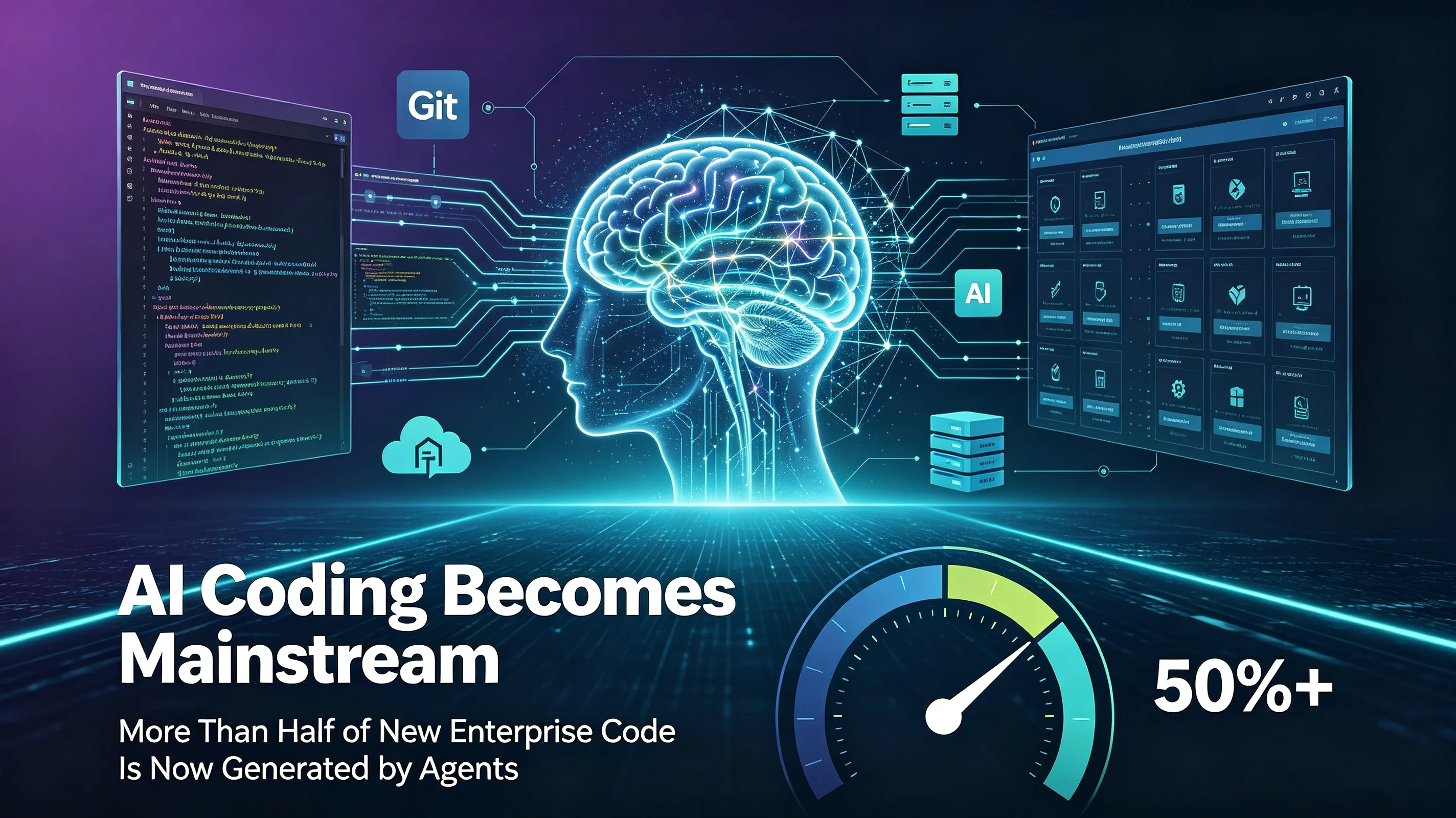
Multiple recent surveys and company disclosures show that this shift has moved from experimentation into the mainstream. In a growing number of enterprises and professional development settings, AI agents now contribute more than half of new code.
BairesDev’s Q3 2026 Dev Barometer is representative. The survey covered 705 developers across more than 60 countries and 41 enterprise CTOs. It found that 42% of developers now say AI writes at least half of their code—up sharply from just 12% in the same period a year earlier. Only 21% of developers still spend more than half their workweek writing new code from scratch. At the same time, 67% report spending more time reviewing AI-generated code than they did a year ago, and 52% spend more time debugging problems introduced by AI.
JetBrains’ concurrent survey of more than 15,000 professional developers worldwide reinforces the picture. Ninety percent of professional developers use AI coding agents at work at least weekly; 68% use them daily. On average, developers report that roughly 47% of the code they produce is fully generated by agents, with a substantial additional share written with AI assistance. More than half of developers now write less than 20% of their code fully manually, and about one in five writes virtually none without AI help.
At the company level the numbers are even more striking. Google has stated that 75% of its new code is AI-generated and then approved by engineers. Anthropic has reported that more than 90% of its own code is written by AI. Snap, Airbnb, and various startups have publicly cited figures well above 50% for new code. A Black Duck study found 97% enterprise adoption of AI coding assistants, with more than half of teams reporting that total code volume has grown by over 25%. The open-source world shows the same pattern: analysis of critical repositories found that AI-agent co-authored pull requests rose from about 2% in late 2025 to around 10% by mid-2026, with absolute volume growing sixfold in six months.
The leap has been driven by the maturation of agentic coding tools. Early autocomplete systems could only suggest the next line. Today’s tools—Claude Code, Cursor, OpenAI Codex, and others—can accept high-level goals, explore codebases autonomously, write multi-file changes, run tests, and iterate on fixes with limited human intervention. JetBrains data shows that 39% of professional developers worldwide use Claude Code at work (47% in the United States), making it the most widely used AI coding tool in many surveys; Cursor, Codex, and GitHub Copilot remain significant players.
McKinsey’s 2026 State of AI survey notes that software coding agents are among the most rapidly scaled agentic use cases. Roughly one in five organizations overall (and 31% of large enterprises) report scaling them. More notably, 32% of respondents said their organizations had decided against purchasing at least one software product or feature because they could build the functionality themselves with agentic coding tools—direct evidence that AI coding is reshaping build-versus-buy decisions.
The role of the human engineer is shifting upward as a result. Time previously spent writing code has largely moved into higher-judgment work: reviewing the quality and security of agent output, debugging subtle defects the models introduce, and deciding what ultimately ships. In the BairesDev survey, 78% of CTOs reported increasing spending on code review, quality assurance, and validation to handle the surge in AI-generated work. Final accountability for shipping still rests overwhelmingly with humans; only a small minority report fully delegating that decision to AI.
Productivity gains are real but uneven. Many teams experience faster delivery and higher code volume. At the same time, research cautions that sharp increases in code generation do not always translate proportionally into software successfully shipped to production. Discipline around review, integration, and quality control matters more than ever.
Rapid adoption has also surfaced new operational challenges. Governance lags behind usage—most developers want clear tracking of AI-generated code for debugging, security, and accountability, yet fewer than one-third of teams currently have full systems in place. Expanding code volume enlarges the security attack surface. Hallucinated or inaccurate suggestions remain a common frustration, and concerns about potential skill atrophy among junior developers are frequently discussed. More enterprises are beginning to treat review, testing, and observability of agent-generated code as first-class infrastructure rather than after-the-fact fixes.
Taken together, the 2026 data is unambiguous: in a growing share of enterprise and professional development settings, more than half of new code is now generated by AI agents. AI coding has moved from an experimental productivity aid to everyday production practice. The most successful teams are those that acknowledge this division of labor and redesign their workflows around it—treating agents as high-throughput collaborators that require strong oversight rather than as fully autonomous replacements. The question is no longer whether this will happen, but how quickly organizations can build the matching review, governance, and operating capabilities to turn the surge in generated code into reliable, secure software.
Transparency Disclosure: Content here is for informational guidance. This publication maintains editorial independence, though some links may generate affiliate revenue. For copyright inquiries or content removal, please reach out to our desk.