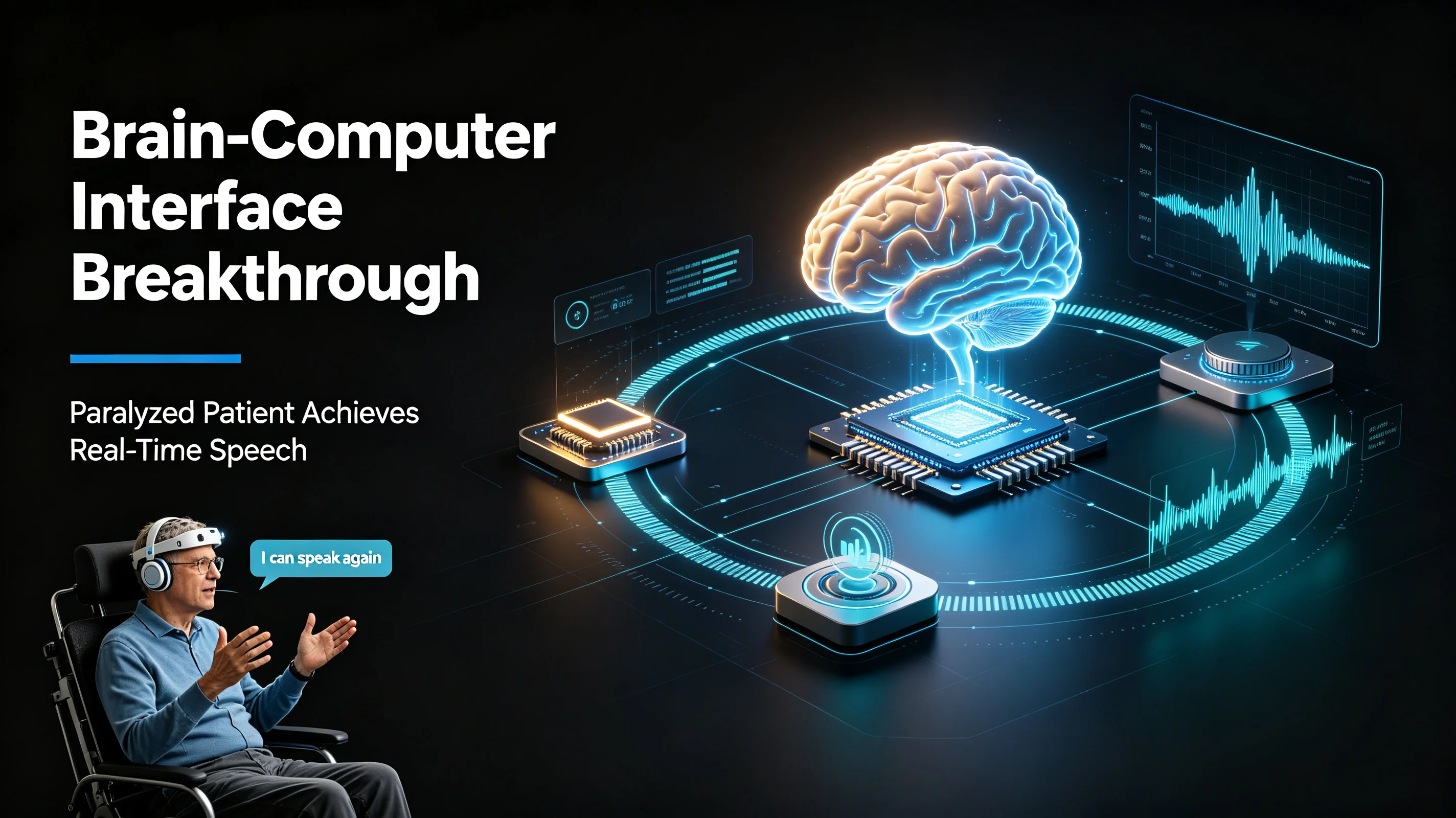
In mid-September, U.S. neurotechnology company Paradromics announced a significant clinical milestone: the first participant implanted with its Connexus brain-computer interface (BCI) successfully achieved near-natural real-time speech communication. The female patient, who has progressive motor neuron disease, was able to generate coherent speech simply by imagining the words she wanted to say—even when her physical ability to speak was severely limited—and engaged in open-ended conversations, including phone calls with family members. Industry observers view this as an important step in moving BCI technology from the laboratory toward practical application.
According to Paradromics, the participant is a woman in her 60s from Michigan. About a decade ago, she was diagnosed with progressive motor neuron disease (a group of conditions that includes amyotrophic lateral sclerosis, or ALS), which has significantly impaired the muscles controlling her mouth and throat. Although she retains limited vocal ability, her speech is largely unintelligible to most listeners, severely restricting daily communication. In June 2026, she underwent implantation of the Connexus system at University of Michigan Health. The system uses a high-density electrode array containing more than 400 electrodes placed on the surface of the brain’s motor cortex, enabling precise capture of neural signals related to speech intention.
During the first free-speech test after the system was activated, researchers invited her to say whatever she wanted. She smiled, and the system quickly decoded and synthesized a clear voice saying: “Okay, I have a lot to say.” This simple yet emotionally charged opening line immediately became the focus of attention. She was subsequently able to answer open-ended questions, independently select her own words, hold natural conversations with family members, and complete real-time phone calls with her grandchildren. The company emphasized that this marked the first time in an early feasibility study that a patient could truly choose what to say, rather than merely completing predetermined copy tasks or selection exercises.
William Marks, M.D., chief clinical officer at Paradromics, stated: “The patient decides what she wants to say, and the system enables her to say it. This represents a major advance in the practical communication capabilities of brain-computer interfaces.” Neurosurgeon Matthew Willsey of University of Michigan Health, an investigator on the trial, noted that after the procedure the patient remarked: “Don’t be afraid. It’s a wonderful experience to be able to help others by your participation in the research study.” The Connect-One early feasibility study plans to enroll up to 10 participants with speech and limb paralysis caused by stroke, ALS, or other motor neuron diseases. Trial sites include the University of Michigan, Massachusetts General Hospital, and the University of California, Davis.
Around the same time, a research team at the University of California, San Francisco (UCSF) reported a related breakthrough. Using an electrode array covering a larger area of the sensorimotor cortex, they achieved the first simultaneous decoding of both speech and physical gestures. Patients could not only produce complete sentences through the BCI but also control a virtual avatar to perform gestures such as waving, nodding, or giving a thumbs-up at the same time, making communication more natural and complete. Study lead Edward Chang, M.D., professor of neurological surgery at UCSF, said: “This is the first time a brain-computer interface has restored both verbal and non-verbal expression simultaneously, bringing us closer to natural human communication.”
Brain-computer interface technology has advanced rapidly in recent years. From the first successful decoding of vowel sounds in 2009, to the decoding of complete sentences by the UCSF team in 2021, and now to real-time, open-ended, and even multimodal communication, the pace of progress has clearly accelerated. Experts believe these developments offer tangible hope for patients who have lost the ability to speak due to neurodegenerative diseases or brain injury. However, the field also cautions that these systems remain in early clinical trial stages. Long-term safety, signal stability, device longevity, cost, and accessibility still require further validation. Additional challenges include adapting the technology to individual patient differences and reducing the invasiveness of the surgery.
Paradromics’ Connexus system is currently operating under an FDA-approved investigational framework, and detailed data have not yet been published in a peer-reviewed journal. The company stated that it will continue collecting data from additional participants and advance the technology toward fully implantable, wireless systems. Analysts expect that if subsequent trials proceed successfully, brain-computer interfaces could gradually transition from research tools into practical clinical solutions that benefit patients within the coming years.
For the millions of people worldwide who have lost the ability to communicate due to paralysis or neurological disease, this breakthrough represents not only a technological advance but also renewed hope of reconnecting with the world. As the patient herself put it during the test—she really does have a lot to say.In mid-September, U.S. neurotechnology company Paradromics announced a significant clinical milestone: the first participant implanted with its Connexus brain-computer interface (BCI) successfully achieved near-natural real-time speech communication. The female patient, who has progressive motor neuron disease, was able to generate coherent speech simply by imagining the words she wanted to say—even when her physical ability to speak was severely limited—and engaged in open-ended conversations, including phone calls with family members. Industry observers view this as an important step in moving BCI technology from the laboratory toward practical application.
According to Paradromics, the participant is a woman in her 60s from Michigan. About a decade ago, she was diagnosed with progressive motor neuron disease (a group of conditions that includes amyotrophic lateral sclerosis, or ALS), which has significantly impaired the muscles controlling her mouth and throat. Although she retains limited vocal ability, her speech is largely unintelligible to most listeners, severely restricting daily communication. In June 2026, she underwent implantation of the Connexus system at University of Michigan Health. The system uses a high-density electrode array containing more than 400 electrodes placed on the surface of the brain’s motor cortex, enabling precise capture of neural signals related to speech intention.
During the first free-speech test after the system was activated, researchers invited her to say whatever she wanted. She smiled, and the system quickly decoded and synthesized a clear voice saying: “Okay, I have a lot to say.” This simple yet emotionally charged opening line immediately became the focus of attention. She was subsequently able to answer open-ended questions, independently select her own words, hold natural conversations with family members, and complete real-time phone calls with her grandchildren. The company emphasized that this marked the first time in an early feasibility study that a patient could truly choose what to say, rather than merely completing predetermined copy tasks or selection exercises.
William Marks, M.D., chief clinical officer at Paradromics, stated: “The patient decides what she wants to say, and the system enables her to say it. This represents a major advance in the practical communication capabilities of brain-computer interfaces.” Neurosurgeon Matthew Willsey of University of Michigan Health, an investigator on the trial, noted that after the procedure the patient remarked: “Don’t be afraid. It’s a wonderful experience to be able to help others by your participation in the research study.” The Connect-One early feasibility study plans to enroll up to 10 participants with speech and limb paralysis caused by stroke, ALS, or other motor neuron diseases. Trial sites include the University of Michigan, Massachusetts General Hospital, and the University of California, Davis.
Around the same time, a research team at the University of California, San Francisco (UCSF) reported a related breakthrough. Using an electrode array covering a larger area of the sensorimotor cortex, they achieved the first simultaneous decoding of both speech and physical gestures. Patients could not only produce complete sentences through the BCI but also control a virtual avatar to perform gestures such as waving, nodding, or giving a thumbs-up at the same time, making communication more natural and complete. Study lead Edward Chang, M.D., professor of neurological surgery at UCSF, said: “This is the first time a brain-computer interface has restored both verbal and non-verbal expression simultaneously, bringing us closer to natural human communication.”
Brain-computer interface technology has advanced rapidly in recent years. From the first successful decoding of vowel sounds in 2009, to the decoding of complete sentences by the UCSF team in 2021, and now to real-time, open-ended, and even multimodal communication, the pace of progress has clearly accelerated. Experts believe these developments offer tangible hope for patients who have lost the ability to speak due to neurodegenerative diseases or brain injury. However, the field also cautions that these systems remain in early clinical trial stages. Long-term safety, signal stability, device longevity, cost, and accessibility still require further validation. Additional challenges include adapting the technology to individual patient differences and reducing the invasiveness of the surgery.
Paradromics’ Connexus system is currently operating under an FDA-approved investigational framework, and detailed data have not yet been published in a peer-reviewed journal. The company stated that it will continue collecting data from additional participants and advance the technology toward fully implantable, wireless systems. Analysts expect that if subsequent trials proceed successfully, brain-computer interfaces could gradually transition from research tools into practical clinical solutions that benefit patients within the coming years.
For the millions of people worldwide who have lost the ability to communicate due to paralysis or neurological disease, this breakthrough represents not only a technological advance but also renewed hope of reconnecting with the world. As the patient herself put it during the test—she really does have a lot to say.
Transparency Disclosure: Content here is for informational guidance. This publication maintains editorial independence, though some links may generate affiliate revenue. For copyright inquiries or content removal, please reach out to our desk.