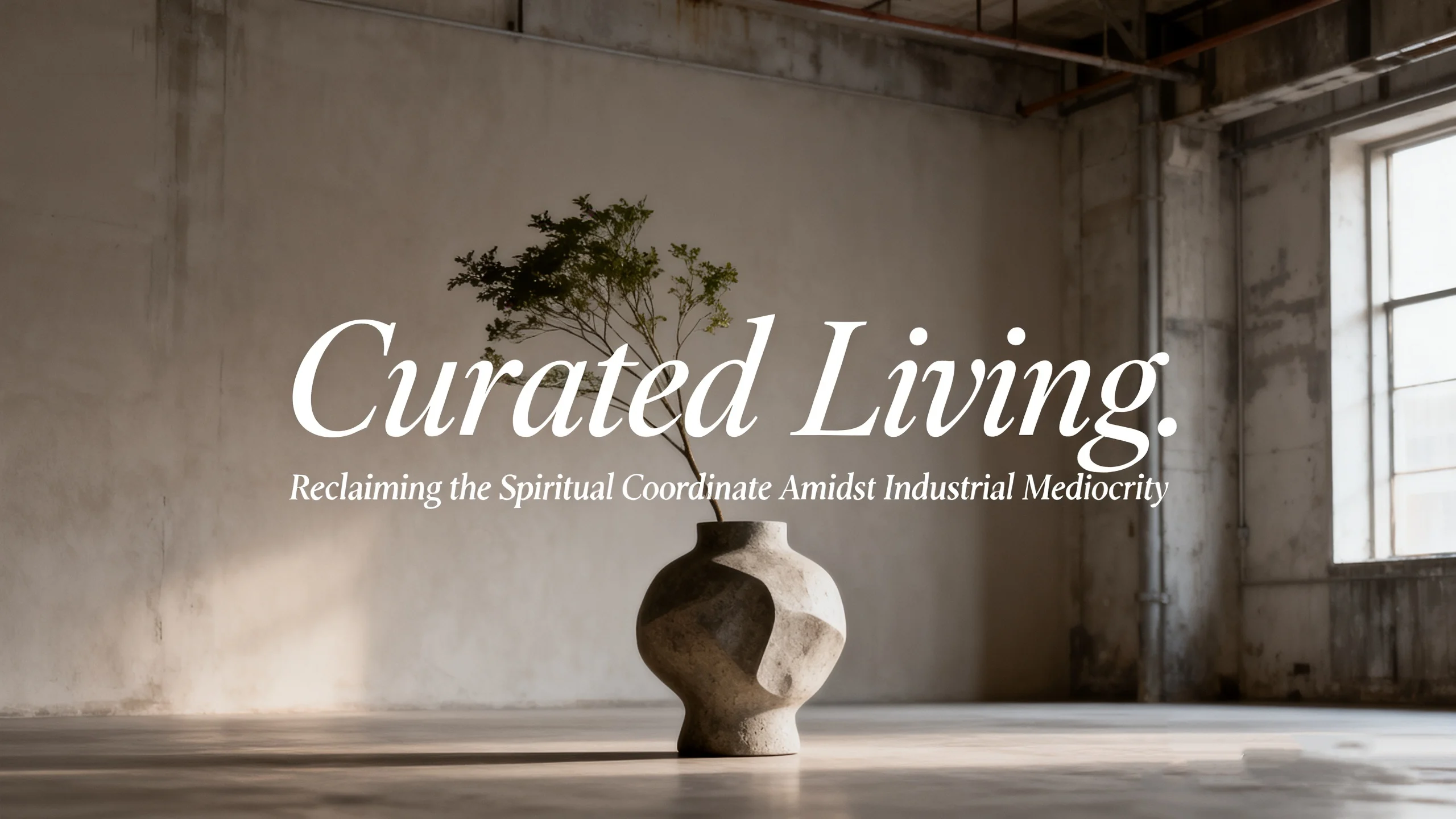
In the private interior circles of London and Milan, a deeply ironic phenomenon is unfolding: the owners of multi-million dollar penthouses now fear nothing more than their home looking like a "newly finished project."
In 2026, if you walk into a space and find every wood tone perfectly matched, and every upholstery fabric smelling of fresh-off-the-line industrial obedience, the space is making a silent announcement. Regardless of the expensive Italian labels attached to the furniture, it declares that the inhabitant possesses wealth, but is utterly bankrupt of taste.
This "wholeness" fed to us by algorithms is, at its core, an aesthetic laziness. It transforms the home into a memoryless, high-efficiency hospitality machine—a hotel room for a life without a narrative.
01 Anachronistic Curation: Shattering the Showroom Curse
The barometer for high-end living has shifted from simple "style definitions" to "Temporal Curating."
The private residences gracing the covers of Architectural Digest or Wallpaper* today are those that dare to place a 19th-century French carved chair alongside a surrealist stainless steel table generated by 3D printing. This visual "anachronism" is an elegant provocation against a world that is too tidy, too logical, and too predictable.
This strategy demands that the dweller act as a "historical curator." Every object that enters the space shouldn't be there to "fill a hole" in functionality; it should be an independent narrative entity with its own biographical value. When a space layers the material traces of different eras, it finally achieves thickness. This tension created by "temporal displacement" is the most expensive element of decor—it is the visual objectification of the dweller’s intellectual depth and spiritual territory.
02 The Provocation of Texture: Building a Sensory Moat in the Silicon Age
Why does modern "minimalism" increasingly feel like a sterile airport lounge? Because they learned the color white but lost the depth of texture.
In this silicon age, surrounded by high-resolution screens and smooth plastic components, seasoned dwellers are becoming obsessively enamored with "Raw Textures." They pair unpolished volcanic rock—bearing the cracks of geological shifts—with ultra-fine mohair. They use raw, unsealed old wood, rich with the patina of scratches, to weight down delicate raw silk cushions.
This extreme contrast in materials is, in fact, the construction of a "sensory moat." It serves as a constant reminder: life is not a smooth, swipeable screen. Life is friction. It is weight. It is that imperfect, aggressive physical feedback. In this provocative pairing, decor is no longer about visual "smoothness"; it is about reclaiming a vanishing "physical reality" through the primal sensory struggle of material possession.
03 The Curation of Shadows: "Regressive Design" Against Visual Bullying
We live in an era of "visual overload." From the bright-as-day offices to the flickering digital terminals, the modern retina is enduring unprecedented bullying. Consequently, the essence of high-end decor is the curation of "shadows."
Those who truly understand living protect the darkness of their homes like a heritage site. They reject the high-lumen, uniform glare of ceiling lights in favor of a "regressive" lighting layout. This requires light sources to be placed below eye level—sometimes even at the height of the baseboards. Shadow here is no longer a deficit; it is an emotional barrier.
Through the precise use of negative space in lighting, the room is cut into countless private "emotional folds." In these corners, where light cannot fully penetrate, your spirit is allowed to retreat from external scrutiny, entering a low-frequency state akin to meditation. This logic is not about "displaying"; it is about "concealing." The best decor allows you to dissolve into a man-made, secure gloom the moment you shed your social masks.
04 Anti-Efficiency Layouts: An Elegant Humiliation of "Convenience"
Modern domestic media is obsessed with "flow optimization," "efficient storage," and "space utilization." But in the logic of curatorial living, these terms reek of lingering workplace anxiety.
A true home should be, to some extent, a "low-efficiency container."
If you must walk around a massive, non-functional sculptural installation just to grab a book, or traverse a long corridor of shifting light and shadow that serves no purpose other than beauty just to pour a glass of water—then congratulations: you are experiencing a noble "anti-efficiency life."
This deliberate creation of obstacles and "redundant space" is an elegant humiliation of the "shortest path principle" found in industrial civilization. It reminds you: this is a home, not an office, and certainly not a logistics distribution center optimized by an algorithm. This layout forces you to slow down, to feel the cool marble beneath your feet, and to observe how light micro-sculpts the surfaces of your objects at different hours. This "luxury waste" of time is the highest grade of dignity decor can bestow.
05 The Final Sincerity: The End of Aesthetics is a "Ruin of the Self"
I have seen too many residences that, in their pursuit of "design," become high-end showrooms. Those places have no human scent, only the sigh of capital.
Ultimately, the most captivating spaces possess an "ordered chaos."
It is the old books on the shelf not aligned by color; it is the Monstera in the corner growing freely, perhaps even intruding into the walking path; it is the strange trinkets you’ve brought back from across the globe that have no logical connection other than a shared ability to make you smile. these things constitute a "sampling" of your life.
In an era where even the soul is being aligned by algorithms, true decor is realizing you don't need to please anyone’s social media feed. You only need to build, within your own cube, a thick shell of objects, shadows, and mockery of efficiency that can wrap around your vulnerabilities and ambitions. The end point of decor is not to achieve a perfect "home," but to find the authentic, scarred, and undefinable self lost in the digital flood.
Transparency Disclosure: Content here is for informational guidance. This publication maintains editorial independence, though some links may generate affiliate revenue. For copyright inquiries or content removal, please reach out to our desk.