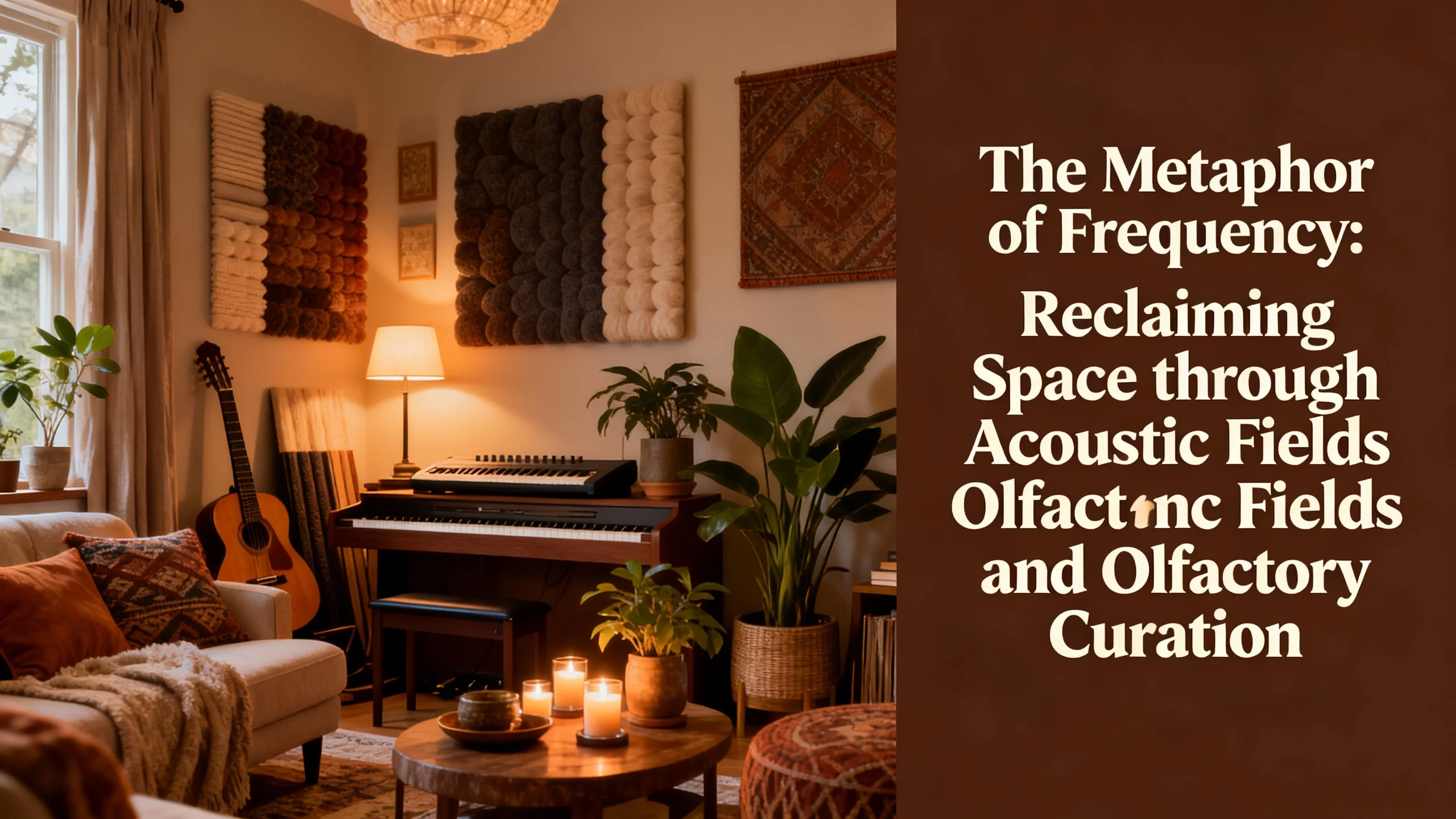
We are living through a period of "visual hyper-inflation." As social media feeds become saturated with curated interior snapshots, the "home" has been reduced to a disposable consumable for the retina. For most, the discourse on decor is subconsciously a discourse on "how to make this space look more expensive through a lens."
However, high-tier dwellers have already staged an early exit from this retinal arms race. They are discussing a space’s "Noise Floor," the "energy conversion efficiency" of materials across different frequency bands, and the "half-life" of scents across various transit routes. In this sophisticated landscape, the most expensive decor is not designed to be seen—it is designed to "shield" and "align."
01 The Acoustic Skeleton: Physical De-noising of Visual Anxiety
In terms of acoustic logic, most homes are a complete failure.
The "minimalist" aesthetic—wrapped in marble, expansive floor-to-ceiling glass, and cold plaster lines—is essentially a massive, aggressive echo box. Every sound, from the setting down of a glass to the tail-end of a conversation, is amplified by the high reflectivity of hard surfaces. This acoustic chaos forces the brain to constantly divert cortical resources to passive noise filtering, leading to a state of invisible "domestic fatigue."
The decor logic of a seasoned dweller begins with "acoustic compensation through porous materials." They will obsessively embed high-density mineral wool within walls or commission vast surfaces of wool felt with specific pleat ratios. These interventions aren't for "quietness" in a traditional sense; they are designed to absorb high-frequency visual anxiety.
When you step into a space with precision acoustic tuning, the silence has weight. It acts as a form of invisible pressure, suppressing the urge to speak and forcing the heart rate to settle. This "psychological closed loop," achieved through the physical coupling of materials, defines a space’s sense of "sovereignty" far more than any chandelier. In this context, decor becomes a decibel filter, converting noise into thermal energy and physically dissolving external intrusion.
02 Olfactory Architecture: Constructing "Invisible Permission Zones"
If light is the soul of a space, scent is its "biological perimeter." While mediocre decor scatters brand-name diffusers haphazardly, professional spatial design engages with "Olfactory Gradients."
This means scent is no longer a mere accessory; it is an "architectural material" participating in the division of space. A deeply realized home possesses a scent profile with a clear logical gradient.
The foyer is typically anchored with the heavy, damp earthiness of vetiver, designed to sever the dweller’s connection to the frantic outside world. Moving into the corridors, the scent should rapidly transition into a low-density woodiness. By the time one reaches the core study, the atmosphere is a dry, crisp field of frankincense and aged paper. This manipulation of molecular weight, airflow, and humidity to control the rate of diffusion establishes an "olfactory permission system" within the inhabitant’s subconscious. Without a single physical partition, it triggers specific neural reflections via olfactory anchors—shifting the brain into a designated psychological mode the moment a specific molecule is detected.
03 Frequency Confrontation: From "Visual Spectacle" to "Life Support System"
Why invest so heavily in things that cannot be seen? Because modern anxiety is, at its root, a "dysregulation of bio-electrical frequency."
In the outside world, we receive high-frequency, chaotic, and random noise and blue light. The home must be the universe's only "Bass Trap." Every decorative decision—from the average pile length of a rug to the micron-level granularity of a nebulizer—is a form of "biological tuning."
The goal is to take a body in a "fight-or-flight" state and, within three minutes of entering the home, forcibly regulate it into a parasympathetic-dominant steady state. This precision control over biological rhythms marks the total transformation of decor from "pure aesthetics" into a "life support system." It no longer matters if a home is "beautiful"; what matters is whether it can physically provide a "low-entropy environment of negative feedback." When the internal sound field is stripped of jagged peaks and scent molecules precisely guide your respiratory rate, this invisible decor finally achieves the true dignity of habitation.
The Hard Truth: Decor is the Absolute Privatization of the Senses
I have seen too many "top-tier interiors" that feel restless due to visual over-exertion. Those spaces are impeccable in a photograph, but the moment you inhabit them, your ears and nose tell you the truth: you are in a wasteland.
A truly elite home should be a place where you can feel "power" even with your eyes closed.
It is the void-like sensation of footsteps being physically neutralized by handcrafted fibers; it is the architectural logic of a scent ladder composed of dry wood and rain; it is the sensation of the world suddenly losing its voice the moment you sit down. In an age where everything can be digitized by a camera, an algorithm, or a filter, these secrets of sound fields and molecules remain a space’s final, inviolable dignity. Sophistication, at its core, is the absolute privatization of this "non-digitizable experience." When your home begins to look after your heart rate rather than your eyeballs, decor has finally fulfilled its mission.
Transparency Disclosure: Content here is for informational guidance. This publication maintains editorial independence, though some links may generate affiliate revenue. For copyright inquiries or content removal, please reach out to our desk.