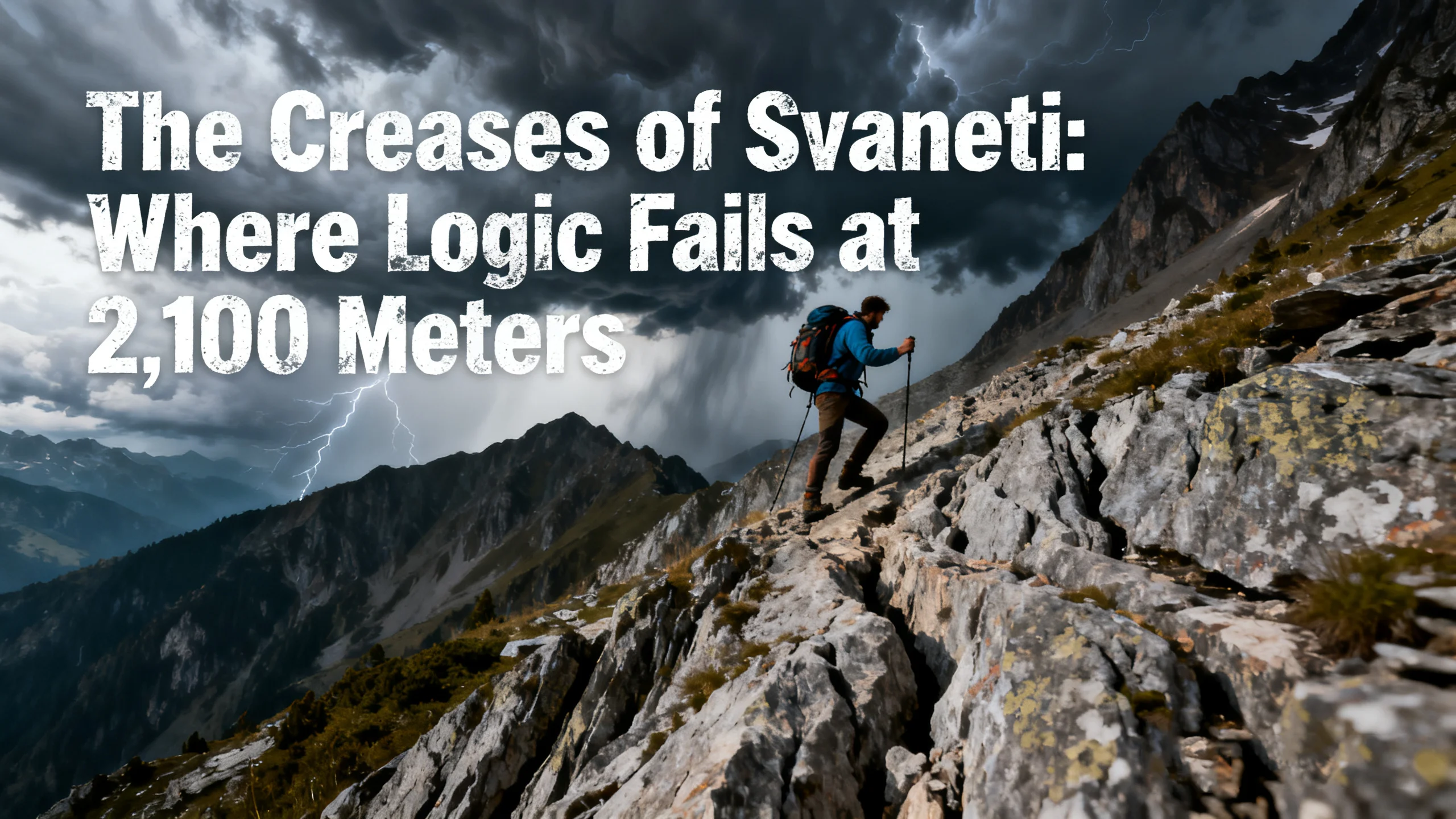
In trekking circles, there is a silent understanding: if a place is marketed as a "photographer's paradise," it is likely a nightmare for your ankles.
Upper Svaneti is exactly that. When you’re hauling a 15kg pack, navigating shale slicked by glacial melt on the goat-trails toward Ushguli, you aren't thinking about "soul-searching." Your brain simplifies into a primal operating system: find a foothold, regulate the breath, endure the twitch of the quads.
01 Shadows of the Koshki and the Survivor’s Instinct
In the early mist of Mestia, the stone defensive towers known as Koshki present a chillingly cold geometry. These weren't built for aesthetics; they were built to survive centuries of blood feuds.
This survivalist logic permeates the land. Once you leave the last café with a stable WiFi signal and step into the deep valleys carved by ice, you realize that nature doesn't welcome your visit; it merely tolerates your transit. The ridgelines here are as sharp as blades, and every ascent is a deliberate attempt to drain your remaining reserves. A veteran knows that the greatest danger here isn't physical exhaustion—it’s the delusion that you’ve conquered something. In Svaneti, the only thing you conquer is your own fear of the uncertain.
02 The Silence of Gear, The Honesty of the Body
I like to observe gear on the trail. Pristine, crease-free Gore-Tex usually belongs to the tourists. The veterans? Their straps are salted with sweat-rings, and the rubber on their toe-boxes is chewed up by scree.
Climbing toward the foot of the Shkhara Glacier, my thighs began to vibrate rhythmically. There is a profound honesty in that vibration. It tells you that no matter how "elite" you are in the city, altitude and incline are the ultimate egalitarians. Under this kind of load, you no longer have the energy to construct social pretenses. Your thoughts are distilled. You notice the smallest details: the way moss grows on river stones, the dry friction of wind through alpine scrub, and the echo of your own heartbeat in your eardrums under the strain of oxygen deprivation.
This "sensory regression" is the most expensive gift of the trail. In civilized society, we rely on a false security born of comfort. Only on a scree slope, in the split second your center of gravity falters, do you truly reconnect with your own flesh.
03 The Threshold of Solitude: Recalibrating Coordinates
In Ushguli—reputedly the highest permanent settlement in Europe—the night sky is so dense with stars it induces a strange claustrophobia. There is no urban softness here, only a primal, aggressive solitude.
We don't fear being alone; we fear losing our tolerance for it. Sitting on the roofs of thousand-year-old stone houses, watching livestock move like ghosts below the snowline, you realize that the rhythm here is measured in centuries. Your anxieties and ambitions don't even amount to a passing meteor. This downward revision of self-importance is the most efficient way to purge the informational garbage from your mind.
04 The Low Hum of the Glacier: A Forgotten "Great Time"
When we talk about "time," we usually refer to the granules sliced up by alarm clocks and planners. But on the final three kilometers toward the Shkhara Glacier, you encounter another kind of time—a heavy, sluggish "Great Time" measured in millennia.
The moraines beneath your feet are the jagged, unstable debris left by the retreating ice. A seasoned trekker knows that every step here is a micro-negotiation with the earth. You step on a stone, and the dull thud of its shift echoes through the valley with a geological lag. This sound isn't crisp; it carries the weight of centuries. The glacier before you is a mottled, dark grey, stained by the rock debris it has swallowed over aeons.
Standing before this massive, weeping wall of ice, you hear a strange sound. It isn’t the wind; it’s a low hum emanating from deep within the cracks. It is the sigh of gravity tearing through solid water. In the face of this scale, your high-tech sports watch, your carbon-fiber poles, and even your own name appear utterly farcical. The glacier does not care who you are. It is merely moving through the creases of the Earth according to its own physical logic. This "non-human indifference" is the most potent sobering agent for the modern urbanite. It tells you that the world was never prepared specifically for you.
05 The "Distillation" of Thought Under Hypoxia
As the altitude climbs above 2,500 meters, the thinning oxygen begins to consciously hijack your brain. This is a beautiful, passive subtraction.
In the lowlands, our minds are vast landfills, stuffed with unread emails, social etiquette, and endless self-dissection. But here, to maintain basic cardiopulmonary function, the brain automatically shuts down its high-energy, non-essential plugins. You stop thinking about "how the world perceives me" and start thinking about "how to budget the next breath."
This is a "distillation of consciousness."
You find that the career anxieties that plagued you for months are drained away with every sharp gasp. Your awareness becomes transparent. You notice a single, tiny bellflower trembling violently in the freezing wind at the edge of the snowline; you observe the subtle sway in your companion’s stride; you hear the rhythm of your own blood thumping against your eardrums. This "purity" brought on by physiological limits is a reality no meditation room can simulate. What we seek in the wild isn't the scenery; it’s this skeletal, stripped-down version of ourselves.
06 The Svaneti Night: The Collapse of Civilized Pretense
Night in Ushguli is the final physical for a modern person’s willpower.
When the last sliver of sunset leaves the snowy peaks, the cold begins to grow from within your own bones. Inside the stone houses, there is a thick scent of aged wood, cow-dung smoke, and damp wool. It is a medieval scent, heavy and grounded. Curled in your sleeping bag, you listen to the defensive towers howling in the wind. Hundreds of years ago, they were built to hide from blood feuds and avalanches; today, they are silent coordinates marking humanity’s grittiest survival instincts in an extreme environment.
In this silence, you feel a peculiar "collapse of civilization." You reflexively reach for the phone in your pocket, only to find it is a heavy, useless slab of plastic. Here, no algorithm will flatter you; no feed will numb you. You are forced to coexist with darkness, cold, and a solitude that is entirely un-filtered.
Veterans love this feeling. Because only when all external support is lost can you see the true color of your own soul. Do you panic without a signal, or do you find contentment in a dim oil lamp? This introspection requires no words; it is a silent trial conducted in the depths of the Caucasus, accompanied by the distant bark of a farm dog.
07 The So-called "Return": Medals of Grime
The descent is usually silent. Knees begin to release a sharp ache from the prolonged pressure of gravity—the body’s interest on its overdrawn account.
When I finally board the jolting minibus back to Tbilisi, looking at the black Svaneti soil under my fingernails and the indelible scars on my boots, I don't feel "purified." I feel a sense of fulfillment that tastes of copper and salt.
This fulfillment comes from having truly contested gravity, having truly endured thirst, and having truly found your coordinates in a ruin where logic holds no sway.
In an age where even sweat is quantified into calorie data, the existence of Svaneti is a reminder that some roads must be traveled the hard way. That pain, that stench of sweat, and the hollowed-out exhaustion of peak effort are the only things you can truly own in this superficial world. If you ask me the meaning of trekking, I will tell you this: the meaning is that when I return to my steel-and-glass office, I can still feel that biting Caucasian wind cutting through my expensive suit, reaching down to a soul that has finally, mercifully, turned hard and cold.
Transparency Disclosure: Content here is for informational guidance. This publication maintains editorial independence, though some links may generate affiliate revenue. For copyright inquiries or content removal, please reach out to our desk.